
Blog

The Fire Quest: Fourteen hours alone in the dark with nothing but a fire to tend

Once a year, at the end of October when the night stretches fourteen hours from 5pm to 7am, I run a version of what is understood to be an ancient teenage ritual, called a “fire quest.”

Teenagers volunteer to tend a fire through the night, from dusk until dawn.  The main parameters: a 24 hour fast, solitude, no watches, phones or torches.  And no sleeping.  Just the ‘quester’, the fire, and the dark.

The task: tend your fire through the night until morning.

It’s perhaps the most “Type 2” experience I have offered – very testing (sometimes miserable) during, and profoundly satisfying after.  But it’s also something more than that.

Joseph Campbell spent decades studying stories across cultures and noticed they all follow the same pattern: the hero crosses a threshold, leaves the familiar world behind, faces trials alone, and returns transformed.  He named this arc “The Hero’s Journey”, and I strongly recommend this book: “The Power of Myth”.

That’s the structure the fire quest follows, in a highly embodied way.

How the ritual works

During the daytime, after having a light breakfast, the last food until that time the next day, the participants spend their time choosing a location to spend the night.  This location must be suitably distant from anyone else, with a feeling of remoteness that matches their appetite.  They forage for fuel: tinder and kindling to get the fire going, logs to last the night, and branches to flare it up if the fire gets low.

We also spend some time in group conversation, where they identify and speak aloud their intentions for the night: what they are committing to in terms of the parameters, and two qualities that they have chosen, that have meaning for them, and that they will seek to practice through challenges of the night.  I remember one of my favourites was when a lad chose “Lightheartedness” and “Devotion” – truly inspiring and very wise, in my view.

At dusk, I light a large fire in the centre of camp.  This is where I’ll stay all night – present but not interfering, available but not rescuing.

The Wolf Pack portal stands beyond the glow of the central fire: a three-metre chestnut with a carved wolf’s head at the top. It has been decorated with bracken and holly berries, and two torches burn on either side.  A path leads from the central fire, through the portal, and out into the woods.

This is the way out. And fourteen hours later, the way back.

One by one, each participant comes forward.  I hand them a glowing ember from the central fire – carefully carried on a chunk of birch bark, or a flat fragment of wood.  They carry it through the portal and out to their spot.

They chose their spot earlier in daylight, and it was easy to go back and forth.  Did they prepare for making the journey in darkness, balancing a precious and precarious ember?  When the light goes, the woods become a completely different place.  Sometimes, this early moment is where they realise how much their previous decisions have mattered!

At night, they can’t see each other. Can’t hear each other. The ones further out are entirely alone.

If they prepared well enough to get to their spot in good time, then it’s time to find out if they put in enough work with their fire preparation – tinder gathered, small kindling laid thick, enough logs stacked to last fourteen hours.  All this seems so obvious in the daytime.  If they prepared well, the ember becomes a flame, the flame becomes a fire, and they settle in for the night.

Every two hours through the night, I do a patrol. I don’t interact, don’t speak – just check from a distance that everyone’s still there, still tending.  They’re alone, but they’re held.

If they haven’t prepared well, the ember dies on the walk. Or it dies before catching. Or, worst of all, they enter a wrestling match with a dying ember, where they burn through all their tinder, and exhaust most of their kindling…  If it doesn’t work, they come back through the dark and through the portal for another ember.  This is not a walk of shame, it’s an important part of the process, and one of the more obvious forms of feedback that the fire quest gifts its participants over the night.

Can they manage their frustration enough to learn from the failure and get it right second time?

Or are they at a stage in their lives where they need some very hard medicine from the fire…

The five-hour failure

One lad spent the first five hours failing.

It started badly and stayed that way. He took an ember and set off into the woods, then realised – there in the dark – that he hadn’t marked his route properly in daylight.  He wandered, uncertain, the ember dimming as he searched.  It died in his hands before he reached his spot.

He came back through the portal and tried again.

When he did manage to arrive in time, another problem surfaced.  He hadn’t gathered enough of the right fuel – not enough thin, dry twigs to catch the ember and coax it into flame.  The ember glowed, smoked, and went out.  Back through the portal.

Each return (there were lots) was quieter than the last.  His jaw set.  His shoulders slumped.  Sometimes there were tears.  Sometimes a kind of brittle determination.

Each time, we sat together by the central fire, and I asked the same two questions: What happened? What will you do differently next time?

His answers changed as the night wore on. At first they were vague, defensive. Then they were resigned, or desperate.  Later they became more precise, as he finally began to slow down, notice and plan.

By this point, the fire was teaching him far more effectively than a person ever could.

By around 11pm – five hours into the night – I judged that he’d had enough fire medicine, and he was ready to move himself on.  I walked him close to his spot so he wouldn’t lose his way, and gave him a proper bundle of dry birch twigs and a generous handful of tinder.

“Pay attention,” I said. “Make it count.”

Then I walked away. And, of course, doubled back quietly to watch from behind a tree.

This time, he didn’t rush. He built carefully. He placed the ember into the tinder, sheltered it, breathed steadily. The ember flared. A small flame was taken by the tinder, which he then fuelled with the kindling, into a fire that would hold.

I left him to it.

He tended that fire until dawn, and didn’t let it die.

In the morning, he was too exhausted to make much sense of the night. He could see, dimly, how hard he’d made it for himself – and how, after that first long stretch of failure, the rest of the night hadn’t felt quite so impossible.

Years later, when we spoke about it again, the lesson had landed more clearly.  He said it was one of the experiences that finally taught him to “lock in – to stop drifting, to take preparation seriously, to stay with things when they got uncomfortable.

The fire hadn’t told him any of that – it had simply refused to work until he changed how he showed up.

What the deep night teaches

For those who get their fire lit without drama, the first few hours feel almost manageable.  There’s novelty, a bit of nervous energy.  The fire is crackling and feels like a win.

But by 10pm, novelty has worn off.  Time becomes unmeasured – only the moon (if it’s out, if they remember to watch it) offers any sense of how far through the night they are.  Cold arrives, maybe rain.  The fire demands constant attention, but beyond that, there’s nothing to do. Boredom – real, unavoidable boredom with no escape route – settles over everything.

And so it becomes all about the fire.  Too many logs and it rages wastefully, burning through their supply. Too few and it starts to die, and their hopes with it. They have to stay present.  Read the flames.  Adjust.  Tend.

By 2am, they are truly in the void – no idea how long they’ve been awake, no idea when dawn will come.  Hungry, cold, tired.  The initial determination – I’m going to do this, I’m going to succeed – has dissolved. They’re not achieving anymore, not performing. Just sitting with the fire, and with the passages of thoughts and changing emotions that flicker in and out like the flames.

Alan Watts* spent his life trying to explain something Western culture finds almost incomprehensible: that you can’t find yourself by looking for yourself.  The more you grasp for identity, security, or self-knowledge, the more it slips away.  He called it the backward law.

The fire quest works because it exhausts the grasping.  It’s fourteen hours of nothing to do except tend a fire and sit with what’s actually present when all the striving stops.

Watts would probably say the teenager doesn’t ‘discover who they are’ through the fire quest.  They discover that the question itself was the problem.  But they are unlikely to get to that level of philosophical insight. They come back different. That’s enough.

It’s uncomfortable, but they put up with it. That’s the point.

* Alan Watts is a hero of mine, and a big influence.  A book of his to read before you die: The Wisdom of Insecurity.

The Return

When they come back through the portal at dawn, they don’t say much.

They’re smoked, hollow-eyed, and slow.  But there’s a steadiness in them, the kind that comes for completing something difficult.  No swagger, just a quiet confidence and a note of humility that is very pleasing to see in a teen.

They stayed.  They kept the fire alive.  Or maybe they didn’t – often the fire dies because they were unable to stay awake.  This is a healthy, valiant failure that is just as valuable.  The main thing in that they stayed out in the arena – they didn’t quit.

Later, over a fried brekkie round the fire and the first real warmth of the day, the stories begin to surface.  They are mostly practical and understated, but full of small moments that mattered more than they realised at the time.

Years later, the meaning arrives.  One told me that it taught them they could handle more than they thought.  Another remembers it as the first time she’d ever sat with herself without distraction. The five-hour lad said it taught him to lock in.

They don’t always know what crossed with them when they crossed the threshold.  Only that they did – and that something useful came back.

About the fire quest

The fire quest runs once a year, in late October, and is by invitation only for teenagers (ages 12+, a window when experiences like this land particularly well) who have attended my Wolf Pack programmes Feral Fathers expeditions and are ready for this level of challenge.

For most teenagers, the fire quest isn’t a starting point — it’s something they grow into.  If you’re interested in multi-day expeditions that might lead to fire quest eligibility, or woodland weekends as an entry point) a night sleeping in a den you’ve made is a good step in the right direction!):

Learn more about woodland weekends → 
Learn more about expeditions →

Email: cpacke@yahoo.co.uk | WhatsApp: 07940 272474
Social media isn’t the problem (and neither is sugar or fast food)

It’s reassuring to have a villain.

At the moment, one of the big ones is social media (which I have written about specifically in a separate post). There are plenty of others: sugar, fossil fuel companies, the education system, fast food, video games.

The pattern is familiar. We identify an external force, blame it for our problems, and demand someone regulate it.  Surely now things will improve.

Except they rarely do, because we tend to look in the wrong direction.

I recognise this pattern because I fall into it myself – I do love to equip myself with a good oversimplification.

The social media ban as a microcosm

The UK is considering following Australia in banning social media for under-16s.  Many parents feel relieved, and politicians look like they’re “doing something” about youth mental health.

But the story underneath it sounds like: “Social media does this to us.”

Rather than: “We’re making choices that are harming us.”

The phone becomes the agent. I become the passive recipient.

That framing is backwards.

The bits we often skip over

A few things can be true at the same time: social media companies do design highly compelling products… those products do exploit psychological vulnerabilities… and teenagers do struggle with self-regulation.  All true.

But there are also some truths we tend to leave out.  Many of us haven’t developed much tolerance for boredom or discomfort, so we often reach for distraction automatically.  We might inadvertently seek to fill every spare moment with something.  When it comes to phones, we are modelling our own phone habits constantly, whether we intend to or not.

None of this makes us bad people. It makes us human, living in a particular environment.  But if we refuse to acknowledge our side of the equation, banning platforms starts to look like wishful thinking.

Why external blame is so appealing

The “ban it” approach is attractive because it feels clean and decisive.  It also relieves us from looking at our own habits.  If the problem lives out there, I don’t have to look too closely at what I do, what I model, what I avoid.

It’s much easier to say: “These platforms are predatory – we’re victims,” than it is to admit that I struggle with discipline, I don’t always enforce boundaries because it’s tiring, I use screens for relief and convenience and I avoid boredom as much as my kids do.

The external blame route has become very normal.  There’s much less talk of personal responsibility or life skills, and even less modelling of them by adults.

This pattern isn’t unique to social media

Social media is just the most recent example of a broader cultural habit: locating problems entirely in systems and institutions, while quietly ignoring our own participation in them.

You can see it everywhere.

“The food industry makes us unhealthy.” True, but so do the choices we make at the supermarket.

“Corporations are destroying the planet.”  Yes.  But what about the daily choices we make that prioritise ease and consumption?

The external factors are real, but it isn’t the root cause – it’s the part that allows us to look away from ourselves.

Accountability isn’t about blame or shame. It’s about noticing where agency still exists, even in imperfect systems.

It’s uncomfortable, because it means admitting: yes, the world makes bad choices easy. And yes, I still have agency within that. And yes, using it requires effort, with no villain to absorb the blame when I fall short.

Which is precisely why externalising is so tempting.

Why this matters beyond social media

Even if a social media ban passes, and even if it helps a little, the underlying pattern remains.

If we don’t address our tendency to avoid responsibility and discomfort, nothing fundamental changes. We’ll regulate one thing, then move on to the next distraction, the next convenience, the next villain.

Because the real issue isn’t the availability of temptation, in practice it’s our limited capacity to resist it.  That capacity is internal, and no policy can build it for us.  But – and this matters – capacity doesn’t develop in a vacuum. Environments either support it or undermine it.  Which is why where we spend time matters as much as what we decide.

Environments shape behaviour

The environments we’re in have a huge influence on how we behave. Going against the grain of our surroundings is genuinely difficult.

That’s why environments that support agency matter so much — environments where distractions are reduced, discomfort can’t be avoided, choices have real consequences, and effort leads to tangible outcomes.

Outdoor settings do this naturally. With no phone signal, no central heating, and no instant entertainment, you’re forced to respond to what’s actually in front of you. You discover, often to your surprise, that you’re more capable than you thought (especially on multi-day experiences, where you get to reap the delayed rewards of Type 2 Fun).

The same principles can apply at home, too, if we’re willing to design for them.

But they all require something uncomfortable: actively taking responsibility.

The pattern continues

Ban sugar advertising. Remove smartphones from schools. Ban social media.

Some of these measures may be justified. External factors matter.  But they’re not the root.

Until we’re willing to rebuild our capacity for discipline, discomfort, and delayed gratification – and to model that to our children – we’ll keep searching for new things to ban while making the same choices that brought us here.

—-

About Feral Fathers

The weekends I run take place in the woods, where phones don’t feature, comfort isn’t guaranteed… and agency tends to emerge.

Feral Fathers runs lively weekend camps for fathers and children in Sussex woodland (for ages 8+) and multi-day expeditions in the hills (ages 12+).

Learn more about woodland weekends → 
Learn more about expeditions →

Email: cpacke@yahoo.co.uk | WhatsApp: 07940 272474
Why banning social media for under-16s won’t fix “teen screen addiction” (and what actually helps)

Australia’s done it, and it looks like the UK might follow: banning some of the major social media platforms for under-16s.

Many parents feel relief that the thing they believe is wrecking attention, mental health, and even basic conversation might finally be addressed.

I understand the relief.  Over the last decade I’ve brought countless groups of teenagers into the woods on expeditions and outdoor events. When I speak to parents beforehand, they often describe what they’re seeing as “screen addiction.”  I’m not convinced that’s quite the right word – but it does point to something real.

And it’s not just the parents who feel relief. On these events I’ve noticed a consistent pattern when teenagers walk away from their phones: a visible unwinding.  Nervous energy settles. Many clearly appreciate being phone-free for more than 48 hours.

I’ve also noticed how quickly the phones come back out the moment they get into the car at pickup.

So – a social media ban. OK.

The problem is a familiar one, so allow me a cliché: the ban treats the symptom, not the cause.

What a social media ban might actually do

Restricting social media is probably a worthwhile move.

Tech companies design powerful platforms that are engaging, frictionless, and endlessly novel – that is literally what they exist to do. Teenagers aren’t yet equipped to regulate something that powerful, yet we gave them unrestricted access and were shocked at the problems that emerged.

If the ban is implemented in a way that teenagers don’t immediately bypass (a big assumption), it may create some useful space. Less comparison. Less cyberbullying. Less exposure to genuinely strange and harmful content.  Any clear boundary would be a positive outcome.

But the impact is likely to be limited.

After a ban, many teenagers would still struggle to sit with boredom (the importance of which I have written in a specific post here). They’d still have a low tolerance for difficulty or uncertainty (the importance of hardship I have written about in a post here). And so they’d still reach for distraction the moment something felt uncomfortable.  As far as I can tell, many smartphone-era teenagers haven’t learned what to do with themselves when there’s nothing to do.

And if we’re honest, many adults have forgotten too.

The real addiction: escaping discomfort

Nir Eyal, who researches distraction and wrote Indistractable, makes a crucial point: we don’t get distracted by our devices — we get distracted away from discomfort.  The device is just the escape route.

Teenagers aren’t on social media so much simply because the apps are compelling. They’re constantly there because the apps offer immediate relief from uncomfortable feelings: boredom, loneliness, anxiety, awkwardness, uncertainty.

Those feelings are normal human experiences. Social media didn’t create them – it just became the fastest way to avoid feeling them.  Take the phone away, and the feelings don’t magically disappear. Without new skills, teenagers will simply find the next available escape – whatever is still allowed.

This continues until they learn how to stay present with discomfort without immediately numbing or avoiding it.

How we created the vulnerability

We’ve built a world where discomfort has been steadily engineered out of teenage life.  The house is never too hot or cold.  Boredom is treated as a problem to be solved within seconds.  Physical challenge is limited, so teenagers rarely discover what they’re capable of handling.  Free roaming has shrunk, meaningful risks have diminished, and weekends are scheduled so tightly there’s little room to figure out what to do with themselves.

None of this is malicious. It’s convenience, safety, good intentions – layered over decades. But the result is that external discomfort has been removed almost entirely. And then we handed them a device that provides instant relief from internal discomfort.

Are we really surprised they struggle to put it down?

Why the outdoors helps so much

Outdoor environments remove escape routes and reintroduce manageable discomfort – all at once.

Bored? There’s no phone. But there’s a fire to watch, and it doesn’t look like much until you’ve watched it for a while. Cold? You can’t turn up the heating, but you have that fire, so add a log, add layers, move around.  Tired?  There’s work that still needs doing – shelter, food, water – but you’ll sleep well afterwards.  Socially awkward?  You can’t disappear into a screen, but sitting quietly is also fine.

Outdoors, teenagers can rebuild a skill modern life has made much harder to develop: tolerance for discomfort. Boredom, uncertainty, physical challenge, difficult feelings – all survivable, all developmental, all temporary.  Generally, from what I’m told directly by teenagers, they lead to “the best time ever” (especially on multi-day trips, which have huge benefits that I talk about here).

But you can’t learn any of this with a constant escape route in your pocket.

What parents still need to do after a ban

After a ban, parents would still have real work to do.

Actively teaching tolerance for discomfort matters – modelling it, setting boundaries, resisting the urge to rescue.  But the most effective approach has always been experiential: giving teenagers environments where they learn these skills themselves, through doing rather than being told.

That includes:

  • Unstructured time: no screens, no organised activities.
  • Physical challenge: hiking, camping, building things, long days outdoors.
  • No immediate escapes: phone-free meals, journeys, weekends – for adults too.
  • Room to struggle: resist rescuing them from every hard moment.

Most important of all is modelling. If we reach for our phones at every awkward silence or dull moment, we teach them that discomfort should be avoided.

There’s harder work to be done than banning things

The social media debate is a useful step, but it isn’t a solution. It’s part of a wider pattern of only looking for external forces to blame, while not also looking to individual behaviour and accountability, which I write about here.

The real question is: what do we do with the space a ban creates?

Do we fill it with different screens and distractions, or do we help teenagers rediscover boredom, uncertainty, effort, and the quiet confidence that comes from handling them?

That work can’t be outsourced to policy.  It requires parents to tolerate our own discomfort too: watching our children struggle, stepping back, and – perhaps hardest of all – putting our own phones down.

—-

About Feral Fathers

This is what happens on our weekends – no phones, no distractions, no escape routes.  Just time in the woods mucking around in a feisty tribe.

Feral Fathers runs lively weekend camps for fathers and children in Sussex woodland (for ages 8+) and multi-day expeditions in the hills (ages 12+).

Learn more about woodland weekends → 
Learn more about expeditions →

Email: cpacke@yahoo.co.uk | WhatsApp: 07940 272474
Type 2 fun: why teenagers need hardship, not happiness

I’ve come to believe that what teenagers need most right now isn’t the pursuit of happiness – it’s quests involving hardship.

This isn’t a call to make teenagers miserable, or to romanticise suffering.  It’s an observation about development: that becoming capable often requires experiences that don’t feel good while they’re happening.

The outdoor world has a useful name for this pattern: it’s called “Type 2 Fun.”

Type 1 Fun: enjoyable while you’re doing it, enjoyable in retrospect. Thorpe Park, a game of Werewolf, Oreo Biscoff banoffee thickshake.

Type 2 Fun: very tough while you’re doing it, deeply satisfying in retrospect. Summit pushes, ice plunges, studying for a driving theory test.  Breaking up with a psycho girlfriend?

Type 3 Fun: not fun during, not fun after – best avoided.  Likely to contain injury, genuine danger, trauma. For me, opera also falls into this category.

Most teenagers can live almost entirely in Type 1 territory. And that’s a problem – not because pleasure is bad, but because it can become the only reference point they have for what “good” means.

One of the most meaningful challenges that teenagers are faced with is dealing with the lack of meaningful challenge.

Why modern teenage life skews so heavily toward Type 1

Being lost used to be a thing, and quite a useful educational tool.

A generation ago, being lost meant sitting with not-knowing. Looking at a map or the Streetmap screenshot you’d printed, figuring it out, maybe asking someone. There was a gap between ‘I don’t know where I am’ and ‘I know where I am.’ You had to sit in the discomfort of being lost while you worked it out.

Now there’s Google Maps, and no more gaps. The discomfort is relieved in seconds, we have lost the feeling of being lost.

That pattern is everywhere – instant gratification provided by apps, for food (Just Eat), entertainment (Netflix), and Everything Else (Amazon Prime).

Type 2 Fun requires living in the gap. And if you’ve grown up never experiencing it, you don’t know it exists. (I’ve written about how boredom – that uncomfortable gap where nothing’s happening – has been almost completely removed from teenage life).

Why Type 2 Fun matters for development

Type 2 Fun isn’t just “character building” in some vague moral sense. It teaches four important lessons that Type 1 Fun cannot.

This delayed gratification, effort now, reward later, is the first one. When there is a gap between satisfaction and payback, the satisfaction is often much deeper and more lasting.

Accurate self-assessment is the way I’d describe the second bit of wisdom.  First-hand experience.  They discover what they’re actually capable of under real conditions, not what adults tell them they’re capable of in comfortable settings.  This can build the sort of confidence that is not inflated or brittle.

The third one is the difference between discomfort and danger.  Most teenagers conflate the two. Type 2 Fun teaches that feeling bad doesn’t mean they’re in trouble – it often just means they’re doing something difficult.  In a world where they have been exposed to constant updates of global crises and conflicts, it has become very important for teenagers to have a realistic perception of danger in their immediate lives, and not “crash out” at the slightest blip (as my son would say).

The final main gift of Type 2 Fun is real confidence.  Enough of that “you’re amazing!” and “you got this” kind of confidence handed out for participation.  Earned confidence is what’s needed: I didn’t think I could do that, but I did.

Adolescence requires genuine challenges where the outcome isn’t guaranteed – the ones that carry enough risk to actually feel dangerous to them. Without these, young people remain psychologically dependent even as they mature physically. They stay stuck in childhood’s safety rather than stepping into adolescence’s necessary risk.

Type 2 Fun provides this.  Real difficulty where discomfort teaches what comfort never could, rather than staged or exaggerated victories.

This kind of experience matters at any age – but there’s a particular window in early adolescence when it lands with unusual force.  I’ve written separately about why timing matters so much between ages 8–15.

What Type 2 Fun actually looks like

Once a year, at the end of October when the night stretches fourteen hours, I run what I call a “fire quest.” At the end of a series of expeditions through the year, teenagers voluntarily tend a fire from dusk until dawn – no food, no phones, no sleeping. Just the fire, the dark, and hopefully a glimpse of the moon to give an idea of the passage of time.

At dusk, I hand each participant an ember from a central fire. They carry it through the Wolf Pack portal – a three-metre archway carved with a wolf’s head, lit by tiki torches – and out to their spot in the woods. If they’ve prepared well (tinder ready, kindling laid, logs stacked), the ember becomes a fire and they settle in for the night.

If they haven’t prepared well, the ember dies. And they have to come back for another one.

One lad spent five hours failing. Lost in the dark, not enough kindling, fire dying repeatedly. Tears, frustration, resignation… but he kept coming back. At midnight, with a bit of guidance and some birch twigs, his fire finally caught. He tended it until dawn.

Five years later, he told me it was one of the kicks in the backside he needed to learn to “lock in” rather than airily waft through life.

That’s Type 2 Fun. Miserable during. Profoundly rewarding after. I’ve written the full Fire Quest story, including why it’s structured the way it is for maximum Type 2 impact, here →.

Why parents struggle with this

The cultural pressure on parents is relentless.  “Failures” in parenting are not looked on well, and the common sense is “We just want our kids to be happy.”

I understand the instinct. Watching your child struggle is uncomfortable. The protective instinct is strong, and legitimate. No parent wants to cause their child unnecessary pain.

But there’s a paradox: happiness and wellbeing aren’t the same thing.

For fathers especially, this often means learning when not to intervene — and trusting that difficulty can be doing useful work.

The more directly you pursue happiness, the more it eludes you. Happiness isn’t a target you can aim at. It emerges as a byproduct of engagement with something difficult and meaningful – not from optimizing for feeling good.

Teenagers who are protected from all discomfort don’t become happy. They become fragile. They learn that discomfort means something has gone wrong, that struggle indicates failure, and that they need rescue.

Wellbeing – the capacity to handle what life throws at you – requires encountering difficulty while you’re still developing.  Risk is an important factor.  This does not mean danger (they are often mixed up), and certainly not trauma.  Just genuine challenge where the outcome matters.

Parents or teachers who instinctively reach to smooth every rough edge aren’t creating happiness, even though their instincts and the cultural messaging encourages them to.  They’re removing the conditions where real satisfaction develops.

The trust required

Type 2 Fun demands trust from both sides.

From teenagers, it’s trust that the adult leading this is competent and knows it will be worth it, that they won’t be rescued at the first sign of discomfort, and that the challenge is hard but survivable.

From parents, it’s the trust that struggle isn’t the same as harm, that their child is more capable than they (or the parent) currently believe, and that discomfort today builds capacity for tomorrow.

This is what much of my outdoor events are designed around: conditions for Type 2 Fun – then stepping back and letting it do its work.  (But it must be said, on Feral Fathers weekends, there is rather a lot of Type 1 fun too).

Not all fun is created equal

Type 1 Fun has its place. Thickshakes are lovely. Thorpe Park is brilliant. Easy days and relaxed, fun moments matter a lot.

But if that’s all teenagers ever experience, they never discover what they’re capable of when things get hard.

Type 2 Fun is this pattern compressed into a weekend or a week.  The teenager leaves home, enters an environment where comfort isn’t guaranteed, faces genuine difficulty, and returns different.  The growth did not come from being taught something, but because they lived through something hard.

This is why time outdoors matters so much: it creates conditions where difficulty is real, bounded, and meaningful – without needing to be manufactured.

That’s the kind of experience I value most for teenagers, and why I wholeheartedly say to parents that I wish hardship for their children, not happiness.

—-

About Feral Fathers

Feral Fathers weekends are built around outdoor challenge – not pure Type 2, but Type 1 with teeth. Climbing trees, building fires and dens, sleeping out, open to the weather, being in a tribe. Fun during, fun after – but harder-edged than indoor life.

My expeditions are more Type 2 territory. Challenging in their nature, dealing with the physical and emotional demands and the unpredictable environment… and deeply satisfying after.  Once you get going, you’re committed.

Woodland weekends in Sussex (ages 8+). Multi-day expeditions in the hills (ages 12+).  Expeditions for teenage groups.

Learn more about woodland weekends → 
Learn more about expeditions →

Email: cpacke@yahoo.co.uk | WhatsApp: 07940 272474
Why multi-day expeditions work better than day trips for teenagers

Day trips are the backbone of teenage life: the day at the outdoor activity centre, the forest school session.  They are good. They get you out, and they create memories.

But they don’t change anyone.

Multi-day expeditions – three, four, five days in places like Dartmoor or the Lake District – do something fundamentally different. Not because they are longer versions of the same thing, but because duration itself creates conditions that brief experiences simply cannot.

Teacher James Herndon, writing about education in How to Survive in Your Native Land (a remarkable, irreverent book), observed that schools operate on ‘artificial time’ – bells, lessons, arbitrary schedules disconnected from natural rhythms or real needs.  Learning that matters, he argued, requires proper time to unfold.

The same is true in other experiences, especially in the outdoors.  Day trips operate on borrowed time, while multi-day expeditions operate on lived time. For teenagers discovering who they are, that duration transforms the experience entirely.

The second day is when it actually begins

Day one of any outdoor trip runs on nerves first, and then quickly onto excitement.  Everything is new, there’s a significant undertaking ahead, and adrenaline is at work.  Teenagers are still their ‘weekend selves’, just in a different location (I think of it as an ‘indoors mode’).

Day two is different.

The thrill has worn off.  They’re just… here.  On the ground, in yesterday’s clothes, with a day ahead.

They have now arrived.  This is when the real experience begins.

On day trips, this point is never reached. It’s over before the novelty wears off, before anything uncomfortable has to be fully worked through. (I write here about the importance of boredom and avoiding escape routes).

Multi-day expeditions force teenagers through a wide arc of emotion and experience, varying cycles of highs and lows that accumulate into a layered adventure.  By day two or three, they’re not doing the expedition anymore. They’re living inside it.

Gary Snyder writes about the difference between visiting wilderness and inhabiting wildness.  Day trips are visits. Multi-day, you stop visiting.  You become an inhabitant, temporarily – you begin to integrate with it, and gain a sense of being at home in the world.  For a teenager, that wild feeling of belonging in nature is crucial to wellbeing, and profoundly underrated.

Time reveals who they actually are

Teenagers are trying on identities. Some feel real, while some are provisional. It takes robust challenges that test which identities are genuine and which are just performance.

On day trips, the unripe identities stay intact.  There’s not enough time, discomfort, or consequence for anything deeper to surface.

On multi-day expeditions, something else happens. By the second or third day, maintaining a persona becomes harder than simply being yourself.  Energy is finite – the loud one gets tired, the anxious one discovers they cope, the quiet one finds a moment to step forward.

I love how this unveils itself, without any force applied.  Duration does the work, revealing who the actually are.

For a teenager, discovering who they are when they can’t hide is invaluable.  It helps them find their feet… which, even though they have just grown three sizes in six months, is a surprisingly challenging task.

Consequences stretch across days and actually teach something

Modern teenage life is remarkably forgiving: mistakes get reset overnight, discomfort is usually temporary, and poor choices rarely echo forward, allowing the same mistakes to be repeated with low cost.

School operates on what Herndon called “artificial consequences” – grades, detentions, punishments entirely disconnected from the actions themselves.  Get a bad mark, nothing real changes the next day, because there’s no genuine feedback loop.

School operates on what Herndon called ‘artificial consequences’ – grades and detentions disconnected from the actions that caused them. The feedback arrives later, imposed by authority, unrelated to natural results. Get a bad mark on Thursday, your Friday feels exactly the same.  The feedback loop is broken.

Multi-day expeditions restore natural consequences.

Pack your rucksack poorly on day one (or bring one that doesn’t even fit you), your shoulders hurt on day two.  Smash through your snacks on day one, and you’re reduced to begging by the next day.  Allow your feet to get wet, or don’t dry your socks when you do, and you’ve got cold feet for the remainder.

These aren’t punishments, they’re just reality providing clear feedback.  The magic in this is that there is moral development without any moralising.  And because consequences stretch across time, there’s space to adjust, learn, try again.  This is how humans learned for thousands of years before we built systems that protect us from feedback.

So as much as I would love to teach them that their choices shape tomorrow’s experience, that laziness compounds, that you can’t outsource your comfort, and that cooperation isn’t optional when you’re stuck together, it’s better to leave it to be spoken by the hill.  

Real bonds require time – not bonding exercises

One-day outdoor experiences keep groups polite, and roles stay shallow.  I don’t think many individuals are being their raw selves in one of those “3, 2, 1 Let’s Go!” teambuilding situations.

Multi-day expeditions remove that option.  After a hard day’s walking followed by an iffy night’s sleep under a noisy owl, edges start to show.  Especially when faced with the prospect of the same again today.

This sounds negative, but it’s not.  Although we like to applaud positivity, there’s nothing that unites a group like a good whinge.  So… maybe it is negative, but in such a positive way!

It’s the beginning of honesty.

Because there’s no exit, people have to work through it. No one can retreat into politeness or performance; it wouldn’t work. Shared reality replaces social manoeuvring.

This is how trust actually forms: not through bonding exercises, but through staying when things get uncomfortable – and discovering that the group holds.  The result is earned membership and belonging

Group alchemy only happens when there’s time for things to get real.

The inner clock resets

Remember that bad night I mentioned earlier?  That just tends to be Night 1, when they have yet to fully exit ‘indoors mode,’ which is the one where it’s possible to get mad at an owl.

As indoor mode and artificial time fades, without phones, without schedules, without extraction times… there’s a physiological shift.

Sleep deepens.  Teenagers sleep better than they have in months – they are sleeping because it’s dark and they are tired.

Hunger becomes intelligible. “It’s time to eat” is replaced by “I’m actually hungry now.”

Attention stretches, because there is nothing fixing it in place.

When this happens, they are going beyond merely “slowing down” and into internal regulation.  

Their nervous systems recalibrate in prolonged nature time. Circadian rhythms reset to natural light-dark cycles, away from artificial disruptions.  The result is that they feel different, even if they can’t quite put their finger on it.

It’s great to experience your own biology again.

Why this matters

Institutions are a fact of life.  They are essential at scale. But institutional life is characterised by time management, performance measurement and other group-level objectives, and so it encourages orthodoxy over diversity, conformity over individual pace.

For teenagers who are developing at such a rapid rate, it is essential to have time outside of this. Experiences where the unique, slow or quirky can have their time, where masks drop and systems reset. It’s also where parental relationships can really deepen – in different ways with fathers and sons, and with fathers and daughters.

Healthy adolescence cannot be a factory where grown-ups are forged.  It’s a period of individual transformation—messy, uneven, unpredictable.  Transformation needs time and space, which is not something that institutional settings will provide.

That’s why through human history you have seen teenagers enduring prolonged challenges out in nature… and when I’m around, you’ll still see them.

—-

I’m a Mountain Leader who runs multi-day expeditions for teenager groups, and for fathers and children (12+) in Dartmoor, Snowdonia, the Peak District, and the Lake District – as well as weekend camps for fathers and children (ages 8+) in Sussex woodland.

These experiences are designed for duration to do its work, and get you fully out of ‘indoor mode’.

Learn more about woodland weekends → 
Learn more about expeditions →

Email: cpacke@yahoo.co.uk | WhatsApp: 07940 272474

Why daughters need their dads in the wilderness

Your daughter is strong. Stronger than the world tells her she is.

After around age 10, something shifts, in a way that is often challenging for dads. Girls begin navigating an increasingly complicated landscape: friendships become charged with social risk, bodies change in ways that feel public, and the pressure to be perfect, pretty, and pleasing intensifies.

And often, right when she needs you most, you might find yourself pulling back.

Not consciously or deliberately; I experienced it in the beginning with my daughter as a sort of involuntary recoil, which felt very jarring in the moment.

Adolescence makes many fathers uncomfortable around their daughters – that is definitely a thing.  The easy physical closeness of childhood can become awkward, sometimes quite suddenly.  You’re not sure how to be anymore, so you step back, assuming she needs space or preferring her mother handle “girl stuff.”

Research shows this retreat happens consistently across cultures. Psychologist Lisa Damour calls it one of the great losses of adolescence – not for the daughter alone, but for both of you. I have written how there is an important window not to be missed for fathers and sons, and it is true for daughters too.

But there’s a way to stay close that navigates the awkwardness very effectively: take her into the wilderness.

Why fathers often retreat (and what that costs)

Puberty changes things for fathers and daughters in ways it doesn’t for fathers and sons.

Many fathers report feeling suddenly uncertain – your daughter’s body is changing, social dynamics are confusing, and the easy physicality of childhood (wrestling, carrying her on your shoulders) no longer feels appropriate.  There is so much baggage around men and girls in our culture.  The fear of being seen as inappropriate – even predatory – around a developing girl keeps many fathers at arm’s length.  It shouldn’t, but it does.

So you default to distance.  You let her mother handle the “complicated stuff.”  You focus on being the provider, the problem-solver from a distance, the one who doesn’t make things more awkward by trying too hard.  This clear step back can happen at precisely the time when fatherhood becomes most vital.

Mary Pipher, in Reviving Ophelia, describes what this retreat costs: daughters lose access to the adult who could show them that women are strong people who do hard things, not just people who look a certain way and manage social approval.

Rachel Simmons’ research on teenage girls found that fathers staying engaged – physically active together, taking daughters seriously, treating them as capable – directly protects against a confidence collapse many girls experience in adolescence.

The wilderness solves the awkwardness problem because you’re not facing each other trying to “connect.”  You’re both facing outward toward a shared task: navigating to camp, building a fire, setting up shelter, figuring out where you are.

There’s something to do, something real.  The focus isn’t on each other – it’s on the work in front of you.

And that makes staying close possible, even easy, precisely when your relationship might otherwise become strained.

What your daughter is learning about her body (and why it matters what you show her)

There are powerful cultural narratives aimed at teenage girls about their bodies.  Expressed bluntly:

Your body is for other people to look at and evaluate.
Your worth is determined by how you appear.
Your body is decoration, not a tool.
Being pretty matters more than being strong.

Peggy Orenstein’s research in Girls & Sex found that when girls describe their own bodies, they overwhelmingly use appearance-based language. Very few describe their bodies as sources of strength, capability, or power, unless they have been specifically encouraged to do so.

The wilderness reverses this completely. Time outdoors, as I have written, matters for fathers and sons. It matters to for fathers and daughters, but in a different way.

In the woods, your daughter’s body isn’t something to be looked at – it’s something she uses.

Climbing, carrying, building, hiking.  She solves problems that require physical engagement.  Her body becomes clearly and unmistakably a tool, not an object.

When a girl discovers she can handle what the wilderness throws at her, she learns a lesson that runs counter to some of the loudest cultural messages.

Girls who develop physical competence — through sport, outdoor challenge, or hands-on work — consistently show higher self-esteem, stronger body image, and greater resilience to peer pressure and cultural messaging. Later in life, this competence often shapes how they approach intimacy and relationships.

My daughter once told me that the way I treated her as a teenager shaped the level of respect she now expects from a partner.  This insight was profoundly moving, and one I could never have planned, only hoped to support.

So, this isn’t just about “building confidence.”  It’s about fathers playing a fundamental role in how daughters see their own bodies and their relationships.

When fathers stay engaged through adolescence, daughters learn something about how men can be.  They don’t have to guess.

Why “Dangerous Daughters” matters

I have run weekends called “Feral Fathers, Dangerous Daughters” since 2019, and it is named that way deliberately.

Not because we’re doing objectively dangerous things (though we do take manageable risks).  It’s because “dangerous” goes against something culture tells girls they’re not allowed to be.

Rachel Simmons describes the “curse of the good girl” – the expectation that girls should be nice, well-behaved, perfect and pleasing.  But the wilderness has no interest in any of this.

You can’t be “nice” to a fire that won’t start – you have to problem-solve. You can’t stay clean and pretty when there is no shower or mirror, and when no-one cares how you look. You can’t be quiet and small when you are chasing someone else’s dad through the trees.

The wilderness requires girls to be loud, messy, direct, and assertive.  Not performing femininity, just being a person solving problems.

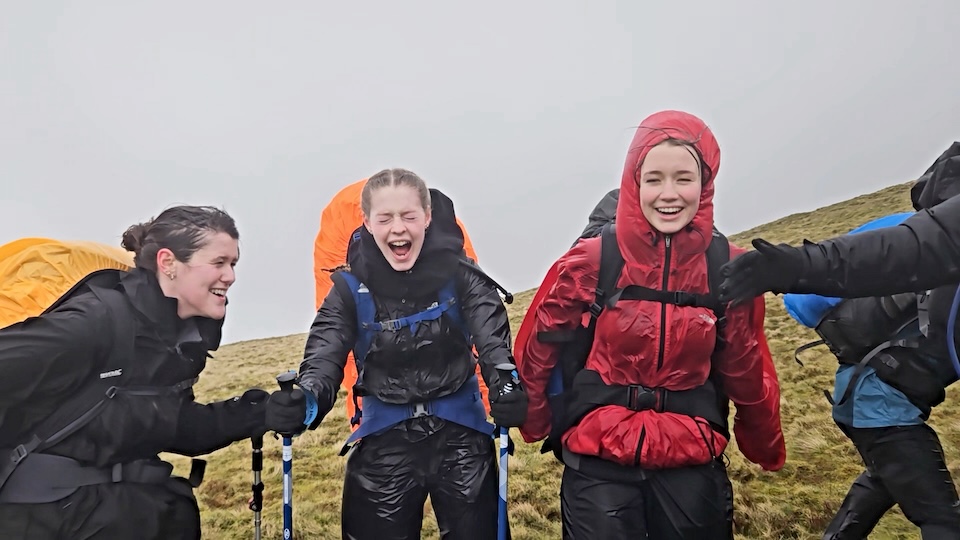
See – it’s not unfair for me to have thought they looked bedraggled

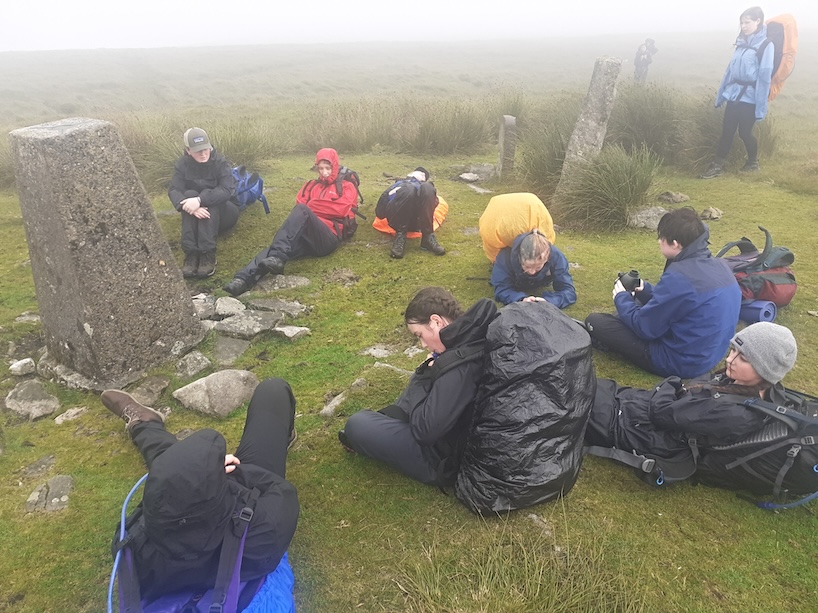
I was with a group of 15 year-old girls on an expedition in Dartmoor, and for a period of four hours on the moor, the weather was absolutely filthy.  I was a bit concerned that the wind and rain might put them off.  On the face of it, they looked so tired and bedraggled.

Later that evening, when the elements had eased and they were cooking their meal ahead of the night wild camping by the River Dart, one of them said: “I’ve done a lot of outdoor stuff with craft and circle time, and that’s fine, but what I really love is to get smashed in the face by a storm.”  To my delight, the entire group agreed, as they tucked into the chorizo and pasta chicken soup they had made.  The next spring, they were happily in the mountains of the Lake District, getting another “storm facial”. They learnt first hand the benefits of getting properly away on multi-day expeditions.

“Dangerous” means: skilful, assertive, and tough.  Shouting back at storms.

It means reclaiming what girls are so often told to suppress.  But something unexpected happens for the fathers too…

I do mean literally shouting back at a storm

It’s not just the daughters who grow

When fathers reflect on time in the wilderness with their daughters, what surprises them most is not what the girls gained – but what it gave them back.

“My daughter and I had a magical time… and bonding on a level I am not sure it is really possible to do in our everyday lives. It was quite strange re-entering civilisation.  Never again will I tell her to be careful with a sharp knife in the kitchen!” (David)

“That weekend felt like some of the most precious time we’ll ever spend together. I learnt so much about her that I don’t think I would’ve learnt any other way.” (Rick)

A storm in her face helps her face anything

The storm raged around us, the rain lashing and the wind howling.  And yet, in the middle of it, the girls were alive, surefooted, and unafraid… and I felt it too. They were shouting, laughing, and experiencing a freedom the world often tells them they shouldn’t have.

That day, they learned something bigger than any skill: they learned that they can face the elements, and life, head-on.

This is what remaining connected can look like – not smoothing the weather, but standing close while she meets it.

The best lessons aren’t taught, they’re lived.  So take your daughter into the storm.  Let her shout at it, hair everywhere – and let yourself rediscover the wildness of being a father along the way.

—-

Feral Fathers runs Dangerous Daughters weekends specifically for fathers and daughters (ages 8+) in Sussex woodland, along with mixed family weekends and multi-day hill expeditions (ages 12+).

Small groups, no phones, lots of fun and freedom.

Learn more about woodland weekends → 
Learn more about expeditions →

Email: cpacke@yahoo.co.uk | WhatsApp: 07940 272474

Why fathers don’t need to be outdoor experts to take their sons outside

Most fathers want to spend more time outdoors with their sons because they intuitively know it matters.

But many hesitate. Not because they don’t want to, but because they think they need to be the expert guide – confident with navigation, survival skills, wildlife. They worry: Will I deliver something exciting enough? Do I know what I’m doing?

I’m convinced that this is a total red herring, and that the opposite is true.

So often, thanks to TV programmes, memes and shorts, boys arrive talking about “extreme survival.”  A boy and his dad arrived in the woods for a weekend, and the son came out with the classic “Can we hunt a deer?”  The dad looked understandably worried (ummm, I can barely tie a knot!).  I suggested that the boy started by putting up a tent.

Half an hour later, the lad came swaggering back, announcing he’d practically put up the tent by himself… and whether he could now have a biscuit.  His dad, visibly relieved, went off to make a cup of tea.

Everyone got what they needed, and were ready for more.

The boy learned a useful outdoor skill – but more importantly, he was doing something real without being managed through it.  His dad didn’t need to perform competence. He just needed to be there – close enough to notice and far enough back not to interfere.

Why not knowing everything is actually better

Kids don’t want a curriculum, or anything that feels like just more school. They don’t want philosophy or lessons, what they respond to most is the absence of an agenda.  

In other words, climbing a tree is much more important than knowing what tree you’re climbing.

Expertise doesn’t just fail to help – it often gets in the way.  The real challenge is containing the urge to direct. That’s harder than it sounds when everything we’re taught about fatherhood involves Taking Charge and Teaching Things.

Being equals in a shared experience changes the dynamic completely.

The unexpected power of doing less

Less Is More: this is one of the most important insights I learned for my parenting and my outdoor career.

It sounds simple, but it isn’t, because it goes against the cultural (and very indoorsy) grain.  If you can be disobedient in this respect you will find that, paradoxically, children learn precisely the independence and agency that you wish for them.  When you step back and quit aiming for a Win, boys will generate their own ideas, discover their own interests, and you get to enjoy it alongside them rather than managing it.

If this kind of letting go resonates, then “Where Did You Go? Out. What Did You Do?  Nothing.” by Robert Paul Smith is well worth reading.  It was hugely influential on me both as a father and as an outdoor guide.

You don’t need expert knowledge – you just need to go outside

Outdoor time works not because it’s special, but because it’s real.

And it seems to matter most during a particular stretch of boyhood — something I’ve written about in more depth elsewhere.

The world itself is rich and full of stimuli. Once the boots are on and the wind is in your son’s face, Bear Grylls is forgotten and reality takes his place – and it’s glorious.  Weather, terrain, fatigue and time all have a say, and none of them accept the excuses that work indoors.

The father doesn’t need to be the action hero, just the one who went outside. And brought biscuits.

—-

Everything I’ve described here is what Feral Fathers weekends are designed to make possible — not through instruction, but by creating the right conditions and getting out of the way.

Feral Fathers runs woodland weekends for fathers and children (ages 8+) and wild camping expeditions in the hills (ages 12+).

Learn more about woodland weekends → 
Learn more about expeditions →

Email: cpacke@yahoo.co.uk | WhatsApp: 07940 272474

The father–son relationship window: why ages 8–15 matter most

There’s a period in a boy’s life when the father-son relationship carries unusual weight.

It’s not infancy, when care is everything.  This is the realm of motherhood, where dads serve best by serving the mother.  And it’s not late adolescence, when peers, independence, and privacy will often dominate.

It’s the stretch in between – roughly ages 8 to 15 – when a subtle shift is underway that isn’t obvious yet, even to them; their inner world is reconfiguring.

Boys are no longer children… and they’re not yet young men… but their centre of gravity is beginning to move out from the safety of the home, and into the dangerous world: this is now the realm of fatherhood.

And during this window, fathers matter in an incredibly important way.

What’s actually changing between 8 and 15

Around this age, many boys begin to shift their attention outward (at differing rates – slower if they have lots of escape routes to avoid real life).

They become more interested in gaining competence, testing their limits (especially physically) and seeking belonging beyond the immediate family.

They usually won’t articulate any of this (or anything much really).  Often it shows up as friction: restlessness, criticism of their parents, selective withdrawal.  And a decent bit of “peacocking”.  Even though it can be jarring to parents, I love seeing this happen.  It’s a signal – not that there’s a problem to be fixed, but that there’s a developmental transition underway… and an absolutely beautiful one.

The boy is beginning to ask, consciously or not: What kind of person am I becoming, and how do I find my place?  And – brace yourself – Who will show me how to be a man?

These are earth-shattering questions.  And Dads: it is our honour and privilege to be their primary guide in this. 

Why fathers become vital in this phase

During early childhood, a father’s role is largely about presence, safety, and play.  The Procreation role is clearly fulfilled, and attention is often around the masculine roles of Protecting and Providing – keeping the lights on and danger at bay – which are still as relevant as ever for men.

The call to motherhood is pretty clear: it is biological, obvious, and so it is well understood.  The call to fatherhood, however, is not so obvious.  No-one taps you on the shoulder and says, “now”.  It is even possible to think that the father’s contribution might stop after the Procreation stage, that having a father around is optional.

No.  Both roles deserve to be understood.  But fatherhood’s lack of clarity means it needs more conscious attention – especially during this window, when it becomes the most important thing.

Guiding boys through a change in orientation

In the book Iron John, Robert Bly tells of a boy who steals the key to the wild man’s cage from under his mother’s pillow. The boy can’t free the wild man while staying under the mother’s protection. He has to leave safety to access wildness.

That’s what’s happening between 8 and 15. Boys aren’t rejecting home – they’re outgrowing it. The restlessness, the friction, the need to test limits: this is the key being stolen.

Boys enter a phase where it no longer appropriate for them to be kept close.  They become independent enough to be watching how a man moves through the world, and Dad is the First Man.

The boy is looking at how a man handles difficulty, courts risk, responds to uncertainty, engages with effort, manages and extends his own limits.

Fatherhood becomes about helping the boy begin facing, and exploring, the world beyond the home, with all its toil and teeth and temptation.  The role here is less about shaping outcomes, and more about setting the stage for his journey into the world.  It’s not about initiating a boy into manhood at 12, but helping him build the internal foundations that make that transition possible later.

That maturing happens primarily through shared experience, not instruction. Expertise is not needed.

Why nature plays a crucial supporting role

Conversation is generally not used as a method of communication between men and boys as often as in most other relationships, so it’s usually about doing rather than talking.

Boys thrive off experiences that require effort and involve challenge, that are risky and uncertain, and that involve choices that matter.  They also need a sense that things don’t revolve around them (as much as they might furiously peacock).

That’s quite a list, but the outdoors delivers it effortlessly.  Nature is hugely beneficial to fathers and sons. This makes sense, because this is the environment that shaped us into the human beings we now are – physically, emotionally, spiritually, all the ways you might come up with.

Out in nature, neither father nor son is fully in charge.  Weather, terrain, fatigue, and time all have a say, and don’t accept the excuses that work indoors.  Plus, there are just so many cool things to do.

That changes the relationship: the father doesn’t have to be the entertainer or problem-solver, and the son isn’t the consumer of attention.  This shared engagement, inside the awesome and mysterious container of nature, creates conditions that are hard to reproduce elsewhere.

(It is worth noting that the father doesn’t always need to be present – sometimes the role is to send the child out into experiences on their own, and support from a distance. A good example of a formative nature experience that fathers play an important role in ‘sponsoring’ is the fire quest, which lands particularly well in the 12-15 age range, and I write about here →.)

What happens if the window is missed

With no obvious call to action, this ‘window’ can be missed, and it’s possible that no-one notices the loss… but something is lost.

I suspect what makes this omission possible is that, in my view, fatherhood is less understood and therefore less celebrated than motherhood.  They deserve to be on an equal footing, equally critical, but with their importance peaking at different times.  When absence from home (for work, or through separation) is seen as quite normal, fathers should not be blamed for ‘missing the call’.

But without enough father energy during this phase, boys often turn almost entirely to peers, or online spaces.  These can offer belonging and even inspiration – but they can’t offer what a father can: a real, embodied, present guide who knows them.

Once the window begins to close, influence becomes harder to offer directly. The relationship can still deepen – but the leverage point has passed.

Why this matters

Between 8 and 15, boys are assembling an internal map.  Even though they don’t consciously know it, they are asking important questions.  What am I capable of?  What do I do with my energy?  Do I belong – and to what?  What kind of man am I becoming?  Who really sees me?

Girls have menstruation to provide a physical and mythological frame for their deep changes, as women have pregnancy and childbirth.  Boys have no equivalent marker for their transition – no physical signal that something fundamental is changing.  The shift for boys is less obvious, which is why it can be missed – by fathers and by boys themselves.  But it’s happening, and it needs attention.

They need a mentor, a guide, to take them places they can’t go by themselves, and to share experiences where those important questions can be explored, so their maturity can blossom, eventually into full grown men in every sense.

Recognising this, and responding to it, is one of the most important moments of fatherhood there is.  It is a coming of age for us too.

—-

This is what Feral Fathers weekends and expeditions are built around: the 8-15 window, when fathers and sons (and daughters) can build something that matters.

Weekend camps in Sussex woodland (ages 8+). Multi-day expeditions in the hills (ages 12+). Small groups, no phones, lots of fun.

Learn more about woodland weekends → 
Learn more about expeditions →

Email: cpacke@yahoo.co.uk | WhatsApp: 07940 272474

Why teenage boys need boredom (and how screens prevent it)

Boredom has a terrible reputation.

We treat it as a problem to be solved, a sign that something is wrong, or that we’ve failed to provide enough stimulation. If a teenage boy is bored, our instinct is to fix it quickly.

And now we can… instantly… infinitely!  A few taps and boredom disappears.

From my experience working with teenage boys outdoors over the last decade, I’ve come to think this is one of the most significant but under-the-radar problems we’ve created.

Not because boredom is harmful, but because it’s essential, and we’ve almost completely removed it from boys’ lives.

What boredom actually is

Boredom isn’t a sign that something has gone wrong. It’s the uncomfortable feeling that arrives when nothing is demanding your attention – and it used to be one of the most productive states a teenager could find themselves in.

If you don’t rush in to fix it, boredom usually starts doing something valuable.  Anyone who grew up before constant screens will recognise this.  Boredom led to dens, daft games, tinkering, wandering, arguing, inventing things, staring out of windows (I said “valuable”, not “productive”!)

It was the doorway into engagement – not something to be eliminated.

How screens change the equation

Screens short-circuit boredom completely.

They offer constant stimulation and novelty with zero effort, instantly erasing the small gaps where boredom might otherwise do its work.  There’s no need to sit with the uncomfortable gap where something might emerge: the moment boredom appears, it’s gone.

The issue isn’t that screens are evil or uniquely powerful, it’s that they are always available, and they remove the pause where something internal might develop.

Over time, boys don’t learn what boredom turns into — because they never stay in it long enough to find out.

What I see when screens are removed

In the first few hours of a phone-free outdoor weekend, there’s often a low-level restlessness.

It often manifests as walking around, hitting a tree with a stick, which I happen to think is an excellent way to pass the time.  I once found the Chairman of Pret a Manger and Itsu doing just this in my woodland, ten minutes after arriving.

The fire has leaf litter chucked in it a lot at first, and there’s a lot of talk about gaming. Then something shifts.

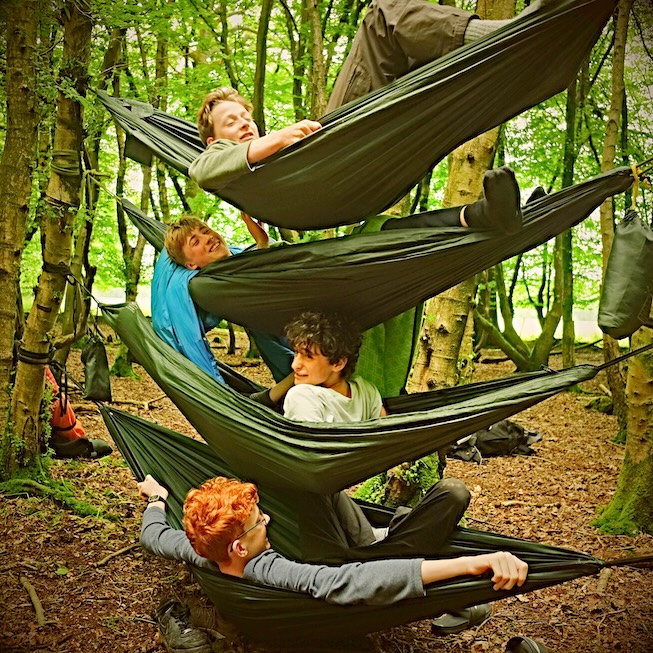
Alongside tasks, activities and games, I alternate with generous periods of no structure or direction.  And after a while, I notice how they begin to settle into this.  You can tell the shift is happening when the focus moves away from destruction and more towards construction: they ask if they can carve a spoon, they go off to make their own fire, or they see how many people can fit into a precarious quadruple-decker hammock setup they have created.

Unnecessary but fun structures arise when you remove unnecessary and tedious structure

Why teenage boys need boredom specifically

Adolescence brings restlessness, awkwardness, uncertainty, and social self-consciousness – truly the best days of our lives!  Boredom is often the space where boys learn to tolerate these feelings without escaping them immediately.

When boredom is constantly eliminated, something else fills the gap – usually distraction. Not because boys are weak, but because they’ve never had reason to develop an alternative.

Many boys know what Creative Mode feels like in a game – that open-ended state where they build and invent without being told what to do.  Real life has a very good version of this, but screens prevent the boredom that carries them there.

Boredom builds something important.  When boys sit in it long enough, they learn to tolerate discomfort without escaping it – and that tolerance is the foundation everything else rests on.  Focus, initiative, confidence: these can’t be taught directly.  They emerge from the other side of boredom.

This is particularly true on multi-day trips, where real life really has the opportunity to influence the experience.

Adults struggle with this too

Adults aren’t much better. We’re just as awkward with silence, and we’ve dressed our own screen dependency up in more respectable clothing: Important Messages, Vital Googling, Admin.

Teenagers are watching this constantly. If we treat every gap as something to fill, they will too.

Let boredom do its work

Boredom needs two things: time, and the absence of easy escape routes.

The outdoors provides both naturally. Screens are physically absent, with no obvious alternatives. And time stretches – which is how my generation spent entire summer holidays doing ‘nothing.’ Dads can harness this memory and relive it with their sons. It does wonders for the son, and for the father-son relationship, to get outdoors together.

The fire quest – fourteen hours alone in the dark tending a fire – is boredom in its most concentrated form. No phone, no watch, nothing to do except tend the fire and sit with what arrives. (Read about the fire quest here →)

Boredom is where agency begins. It’s the moment a teenager realises: I can do something with this. We don’t give that moment anything like the weight it deserves.

At home, it’s much harder, because screens are everywhere and habits are entrenched.  Lecturing boys about screens or attention won’t get the result we want as parents, it just leads to tantrums.  Energy is better spent on exposing him to constructive discomfort, and resisting the urge to rescue him from it… which is most effectively achieved outside.

Once they’ve discovered what lies on the other side of boredom – in the woods, away from screens – that knowledge comes home with them. It doesn’t solve everything, but it builds a healthy habit to counter the screen effect: to stay in the uncomfortable moment, knowing that it’s a place worth staying.

—-

If you want to experience this kind of environment directly, Feral Fathers runs woodland weekends for fathers and children (ages 8+) and wild camping expeditions in the hills (ages 12+).

You don’t need to be an outdoorsman. You just need to turn up and muck around.

Learn more about woodland weekends → 
Learn more about expeditions →

Email: cpacke@yahoo.co.uk | WhatsApp: 07940 272474

Why time in nature matters for fathers and sons – and how to make it happen

Fathers and sons often struggle to connect. Not from lack of compatibility, but lack of context – most modern life happens indoors, scheduled, distracted by screens.

Time in nature changes this.  Nature is not magical, but it offers important conditions more easily than indoor life: shared challenge, real consequences, space for boredom, situations to problem-solve together.

I’ve run woodland weekends for fathers and sons for over ten years. The same pattern happens every time: anxiety or awkwardness soften, competence emerges, connection deepens. No phones, no agenda, just time together doing real things

There’s plenty of research about how challenge, curiosity, and unstructured, screen-free time outdoors build confidence, resilience, and deeper family bonds.  But honestly, you don’t need the studies. You can feel it in the woods.

So why does this work so reliably? And how can ordinary fathers make it happen with their own sons – even if they’re not “outdoor types”?

Why our sons, in particular, need outdoor time

Physical challenge builds confidence

(Daughters, of course need outdoor time, with their dads, but in a different way that I have written about here)

Many teenage boys are wired for physical challenge and manageable risk. They need to test themselves, push limits, and discover what they can handle.

Modern life offers very few legitimate outlets for this.

School is mostly sitting still. Home is often screen-based. Even organised sport, which can be hugely valuable, is highly structured and supervised. The outcomes are usually known in advance.

Nature offers something different: problems where you don’t already know how it will go.

When a 13-year-old manages to light a fire in the rain, builds a shelter that actually keeps him dry, or navigates a few miles with a map and compass, that competence lands differently. It’s not theoretical, and it’s far from a digital achievement. It’s something he feels in his body.

The same, of course, is true for dads.

Natural consequences teach better than lectures

In the outdoors, consequences are immediate and impersonal.

If you don’t collect firewood, you’re cold. If your shelter leaks, you get wet. If you don’t purify water, you stay thirsty.

There’s no arguing with the wind.  We are in the arena of Type 2 Fun here: experiences that are hard, but deeply satisfying.

Boys respond to this reality better than they do to nagging or lectures from adults.

I’ve regularly seen boys who are described as “difficult” at home or school become focused, capable and cooperative in the woods. The environment demands responsibility, and they meet it.

Side-by-side connection works differently

Fathers and sons connect best side by side – walking, building a den, fixing something together.  Being face-to-face and expecting to “talk about feelings” is pretty unrealistic.

Most men already know this.  Nature just makes it easy: there’s always something to do, and conversation happens as a by-product.

One father once told me that he and his 14-year-old son woke up at dawn in the den they’d built and lay there for a couple of hours, listening to birdsong and watching the light change.

“That was the first time we’d hugged in over two years,” he said.

What a thing to hear from a dad – I shall never forget that.

Why nature changes the dynamic

Shared challenge levels the playing field

At home, fathers usually hold the expertise: they know how things work and they set the rules. The son is the learner.

In the woods, especially if neither of you is particularly experienced, that hierarchy softens. You’re both figuring things out in unfamiliar territory. You fail together and problem-solve together.

Sometimes the son teaches the father: a better knot, a smarter way to split kindling, a shortcut he’s found. So often, young lads are remarkably observant, and can spot a robin’s egg where dad just saw another tree.  That reversal matters more than we tend to realise.

Play matters a lot

One of the things boys consistently remember from Feral Fathers weekends is simply seeing their dad playing – winning, losing, laughing – not managing, teaching or supervising.

They’re shocked and delighted: “I didn’t know my dad could be silly.” Or: “I beat him at something and he loved it.”

Fathers performing competence all the time is exhausting for everyone.  Play gives permission to drop that.

Seriousness can seriously get in the way of people connecting.

The absence of screens changes everything

One of the biggest shifts happens simply because phones aren’t there.

At first there’s often a low-level restlessness: checking pockets, the impulse to photograph everything. Then something settles.

Boys start noticing things: sounds, smells, the feel of the sunshine on his face (or sometimes the rain – equally pleasant but less popular) .  The way a fire behaves. Eventually — and this is the gold standard – they get bored.

That might sound negative, but boredom is the doorway to creativity, presence and genuine engagement. Screens eliminate boredom instantly. Nature doesn’t: it tends to get you exploring and experimenting.  (We never quite manage to attain boredom on a Feral Fathers weekend though).

I could write a whole piece about this. The short version is that when escape routes disappear, something important comes back.

Making it happen without being an expert

The most common concern I hear from fathers is: “I wouldn’t know what I was doing.”

That’s fine. Your son doesn’t need you to be Ray Mears.  He just needs you to give it a go.

Start simple: a day walk to a clear destination – a hilltop, a lake, a landmark, or cook a meal outdoors (by ‘meal’ I mean sausages and marshmallows: that is a meal).  Or – a little more daring – sleep out for a night somewhere sensible and low-key (we call this a “micro-adventure”).

Give your son actual responsibility: let him navigate, light the fire, choose the route. Nature makes trust easy, and boys this age are desperate to be trusted and taken seriously by their dads.

Consistency matters more than ambition. A pattern of do-able trips builds the foundation. Then, when trust and capability are established, elaborate expeditions become possible – and magnificent (and here’s what I think of the benefits of multi-day expeditions).

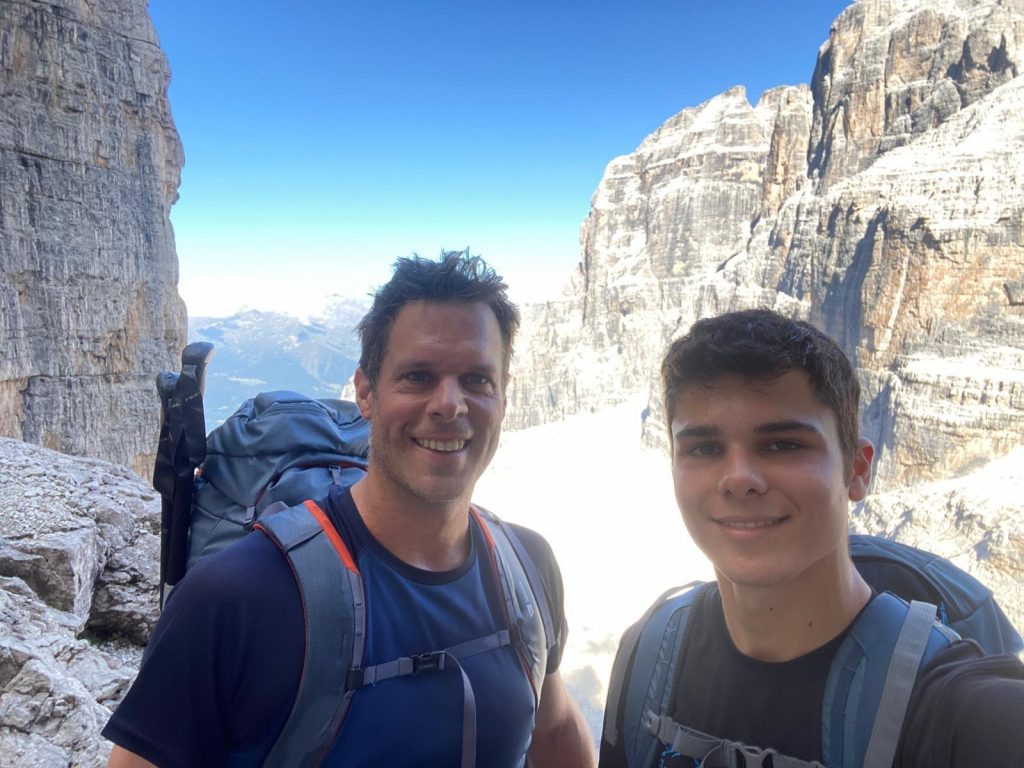
In the Dolomites climbing via ferrata with my son Finn… the best of times

There’s a window — and it doesn’t stay open forever

There’s a window for this – roughly ages 8 to 15. It doesn’t stay open forever.

If your son is in that space now, this matters. Not next year. Now.

It doesn’t have to be perfect

Getting things right is not the point.

Your son won’t remember whether the tarp was perfect or the fire lit first time. He’ll remember that you tried, that you were there, and that you worked it out together.

That’s what builds the bond… while nature – the outside kind and the inside kind – does the rest.

Where this leads next

There are three threads running through all of this that deserve more space:

—-

Experience this with your son

Feral Fathers runs woodland weekends (ages 8+) and multi-day expeditions (ages 12+) – small groups, no phones, real challenges.

Not instruction. Not entertainment. Just conditions where fathers and sons (or daughters!) discover what they’re capable of together.

Learn more about woodland weekends → 
Learn more about expeditions →

Email: cpacke@yahoo.co.uk | WhatsApp: 07940 272474