
Why daughters need their dads in the wilderness
Your daughter is strong. Stronger than the world tells her she is.
After around age 10, something shifts, in a way that is often challenging for dads. Girls begin navigating an increasingly complicated landscape: friendships become charged with social risk, bodies change in ways that feel public, and the pressure to be perfect, pretty, and pleasing intensifies.
And often, right when she needs you most, you might find yourself pulling back.
Not consciously or deliberately; I experienced it in the beginning with my daughter as a sort of involuntary recoil, which felt very jarring in the moment.
Adolescence makes many fathers uncomfortable around their daughters – that is definitely a thing. The easy physical closeness of childhood can become awkward, sometimes quite suddenly. You’re not sure how to be anymore, so you step back, assuming she needs space or preferring her mother handle “girl stuff.”
Research shows this retreat happens consistently across cultures. Psychologist Lisa Damour calls it one of the great losses of adolescence – not for the daughter alone, but for both of you. I have written how there is an important window not to be missed for fathers and sons, and it is true for daughters too.
But there’s a way to stay close that navigates the awkwardness very effectively: take her into the wilderness.
Why fathers often retreat (and what that costs)
Puberty changes things for fathers and daughters in ways it doesn’t for fathers and sons.
Many fathers report feeling suddenly uncertain – your daughter’s body is changing, social dynamics are confusing, and the easy physicality of childhood (wrestling, carrying her on your shoulders) no longer feels appropriate. There is so much baggage around men and girls in our culture. The fear of being seen as inappropriate – even predatory – around a developing girl keeps many fathers at arm’s length. It shouldn’t, but it does.
So you default to distance. You let her mother handle the “complicated stuff.” You focus on being the provider, the problem-solver from a distance, the one who doesn’t make things more awkward by trying too hard. This clear step back can happen at precisely the time when fatherhood becomes most vital.
Mary Pipher, in Reviving Ophelia, describes what this retreat costs: daughters lose access to the adult who could show them that women are strong people who do hard things, not just people who look a certain way and manage social approval.
Rachel Simmons’ research on teenage girls found that fathers staying engaged – physically active together, taking daughters seriously, treating them as capable – directly protects against a confidence collapse many girls experience in adolescence.
The wilderness solves the awkwardness problem because you’re not facing each other trying to “connect.” You’re both facing outward toward a shared task: navigating to camp, building a fire, setting up shelter, figuring out where you are.
There’s something to do, something real. The focus isn’t on each other – it’s on the work in front of you.
And that makes staying close possible, even easy, precisely when your relationship might otherwise become strained.
What your daughter is learning about her body (and why it matters what you show her)
There are powerful cultural narratives aimed at teenage girls about their bodies. Expressed bluntly:
Your body is for other people to look at and evaluate.
Your worth is determined by how you appear.
Your body is decoration, not a tool.
Being pretty matters more than being strong.
Peggy Orenstein’s research in Girls & Sex found that when girls describe their own bodies, they overwhelmingly use appearance-based language. Very few describe their bodies as sources of strength, capability, or power, unless they have been specifically encouraged to do so.
The wilderness reverses this completely. Time outdoors, as I have written, matters for fathers and sons. It matters to for fathers and daughters, but in a different way.
In the woods, your daughter’s body isn’t something to be looked at – it’s something she uses.
Climbing, carrying, building, hiking. She solves problems that require physical engagement. Her body becomes clearly and unmistakably a tool, not an object.
When a girl discovers she can handle what the wilderness throws at her, she learns a lesson that runs counter to some of the loudest cultural messages.
Girls who develop physical competence — through sport, outdoor challenge, or hands-on work — consistently show higher self-esteem, stronger body image, and greater resilience to peer pressure and cultural messaging. Later in life, this competence often shapes how they approach intimacy and relationships.
My daughter once told me that the way I treated her as a teenager shaped the level of respect she now expects from a partner. This insight was profoundly moving, and one I could never have planned, only hoped to support.
So, this isn’t just about “building confidence.” It’s about fathers playing a fundamental role in how daughters see their own bodies and their relationships.
When fathers stay engaged through adolescence, daughters learn something about how men can be. They don’t have to guess.
Why “Dangerous Daughters” matters
I have run weekends called “Feral Fathers, Dangerous Daughters” since 2019, and it is named that way deliberately.
Not because we’re doing objectively dangerous things (though we do take manageable risks). It’s because “dangerous” goes against something culture tells girls they’re not allowed to be.
Rachel Simmons describes the “curse of the good girl” – the expectation that girls should be nice, well-behaved, perfect and pleasing. But the wilderness has no interest in any of this.
You can’t be “nice” to a fire that won’t start – you have to problem-solve. You can’t stay clean and pretty when there is no shower or mirror, and when no-one cares how you look. You can’t be quiet and small when you are chasing someone else’s dad through the trees.
The wilderness requires girls to be loud, messy, direct, and assertive. Not performing femininity, just being a person solving problems.
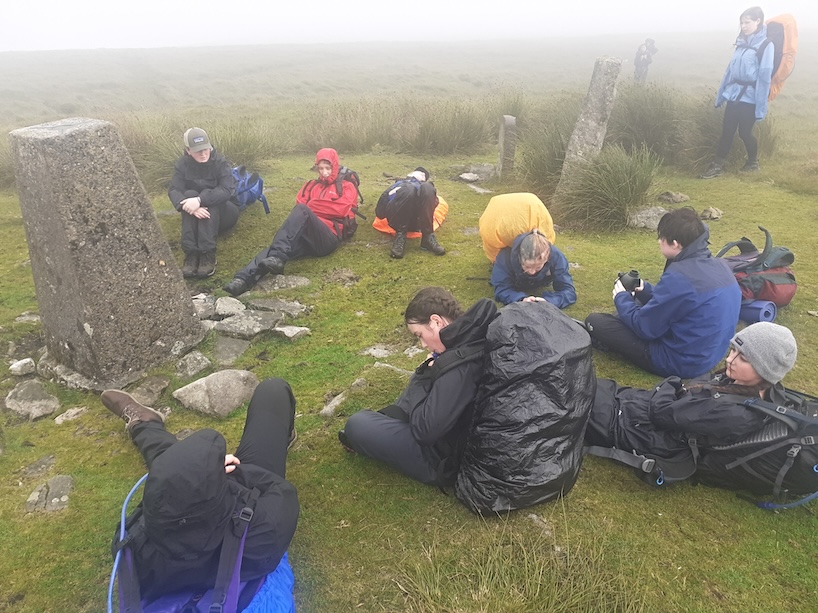
I was with a group of 15 year-old girls on an expedition in Dartmoor, and for a period of four hours on the moor, the weather was absolutely filthy. I was a bit concerned that the wind and rain might put them off. On the face of it, they looked so tired and bedraggled.
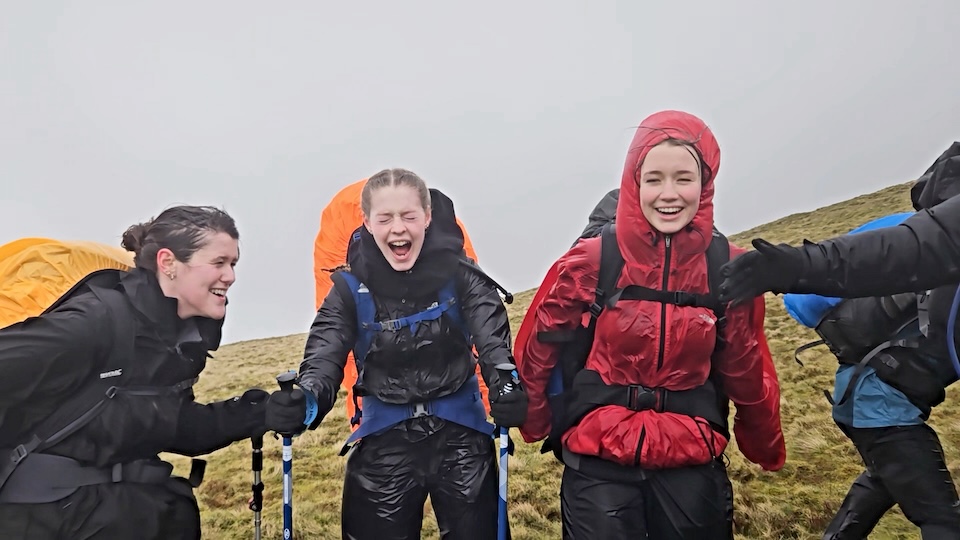
Later that evening, when the elements had eased and they were cooking their meal ahead of the night wild camping by the River Dart, one of them said: “I’ve done a lot of outdoor stuff with craft and circle time, and that’s fine, but what I really love is to get smashed in the face by a storm.” To my delight, the entire group agreed, as they tucked into the chorizo and pasta chicken soup they had made. The next spring, they were happily in the mountains of the Lake District, getting another “storm facial”. They learnt first hand the benefits of getting properly away on multi-day expeditions.
“Dangerous” means: skilful, assertive, and tough. Shouting back at storms.
It means reclaiming what girls are so often told to suppress. But something unexpected happens for the fathers too…
It’s not just the daughters who grow
When fathers reflect on time in the wilderness with their daughters, what surprises them most is not what the girls gained – but what it gave them back.
“My daughter and I had a magical time… and bonding on a level I am not sure it is really possible to do in our everyday lives. It was quite strange re-entering civilisation. Never again will I tell her to be careful with a sharp knife in the kitchen!” (David)
“That weekend felt like some of the most precious time we’ll ever spend together. I learnt so much about her that I don’t think I would’ve learnt any other way.” (Rick)
A storm in her face helps her face anything
The storm raged around us, the rain lashing and the wind howling. And yet, in the middle of it, the girls were alive, surefooted, and unafraid… and I felt it too. They were shouting, laughing, and experiencing a freedom the world often tells them they shouldn’t have.
That day, they learned something bigger than any skill: they learned that they can face the elements, and life, head-on.
This is what remaining connected can look like – not smoothing the weather, but standing close while she meets it.
The best lessons aren’t taught, they’re lived. So take your daughter into the storm. Let her shout at it, hair everywhere – and let yourself rediscover the wildness of being a father along the way.
—-
Feral Fathers runs Dangerous Daughters weekends specifically for fathers and daughters (ages 8+) in Sussex woodland, along with mixed family weekends and multi-day hill expeditions (ages 12+).
Small groups, no phones, lots of fun and freedom.
Learn more about woodland weekends →
Learn more about expeditions →
Email: cpacke@yahoo.co.uk | WhatsApp: 07940 272474