
Fathers & sons

Why fathers don’t need to be outdoor experts to take their sons outside

Most fathers want to spend more time outdoors with their sons because they intuitively know it matters.

But many hesitate. Not because they don’t want to, but because they think they need to be the expert guide – confident with navigation, survival skills, wildlife. They worry: Will I deliver something exciting enough? Do I know what I’m doing?

I’m convinced that this is a total red herring, and that the opposite is true.

So often, thanks to TV programmes, memes and shorts, boys arrive talking about “extreme survival.”  A boy and his dad arrived in the woods for a weekend, and the son came out with the classic “Can we hunt a deer?”  The dad looked understandably worried (ummm, I can barely tie a knot!).  I suggested that the boy started by putting up a tent.

Half an hour later, the lad came swaggering back, announcing he’d practically put up the tent by himself… and whether he could now have a biscuit.  His dad, visibly relieved, went off to make a cup of tea.

Everyone got what they needed, and were ready for more.

The boy learned a useful outdoor skill – but more importantly, he was doing something real without being managed through it.  His dad didn’t need to perform competence. He just needed to be there – close enough to notice and far enough back not to interfere.

Why not knowing everything is actually better

Kids don’t want a curriculum, or anything that feels like just more school. They don’t want philosophy or lessons, what they respond to most is the absence of an agenda.  

In other words, climbing a tree is much more important than knowing what tree you’re climbing.

Expertise doesn’t just fail to help – it often gets in the way.  The real challenge is containing the urge to direct. That’s harder than it sounds when everything we’re taught about fatherhood involves Taking Charge and Teaching Things.

Being equals in a shared experience changes the dynamic completely.

The unexpected power of doing less

Less Is More: this is one of the most important insights I learned for my parenting and my outdoor career.

It sounds simple, but it isn’t, because it goes against the cultural (and very indoorsy) grain.  If you can be disobedient in this respect you will find that, paradoxically, children learn precisely the independence and agency that you wish for them.  When you step back and quit aiming for a Win, boys will generate their own ideas, discover their own interests, and you get to enjoy it alongside them rather than managing it.

If this kind of letting go resonates, then “Where Did You Go? Out. What Did You Do?  Nothing.” by Robert Paul Smith is well worth reading.  It was hugely influential on me both as a father and as an outdoor guide.

You don’t need expert knowledge – you just need to go outside

Outdoor time works not because it’s special, but because it’s real.

And it seems to matter most during a particular stretch of boyhood — something I’ve written about in more depth elsewhere.

The world itself is rich and full of stimuli. Once the boots are on and the wind is in your son’s face, Bear Grylls is forgotten and reality takes his place – and it’s glorious.  Weather, terrain, fatigue and time all have a say, and none of them accept the excuses that work indoors.

The father doesn’t need to be the action hero, just the one who went outside. And brought biscuits.

—-

Everything I’ve described here is what Feral Fathers weekends are designed to make possible — not through instruction, but by creating the right conditions and getting out of the way.

Feral Fathers runs woodland weekends for fathers and children (ages 8+) and wild camping expeditions in the hills (ages 12+).

Learn more about woodland weekends → 
Learn more about expeditions →

Email: cpacke@yahoo.co.uk | WhatsApp: 07940 272474
The father–son relationship window: why ages 8–15 matter most

There’s a period in a boy’s life when the father-son relationship carries unusual weight.

It’s not infancy, when care is everything.  This is the realm of motherhood, where dads serve best by serving the mother.  And it’s not late adolescence, when peers, independence, and privacy will often dominate.

It’s the stretch in between – roughly ages 8 to 15 – when a subtle shift is underway that isn’t obvious yet, even to them; their inner world is reconfiguring.

Boys are no longer children… and they’re not yet young men… but their centre of gravity is beginning to move out from the safety of the home, and into the dangerous world: this is now the realm of fatherhood.

And during this window, fathers matter in an incredibly important way.

What’s actually changing between 8 and 15

Around this age, many boys begin to shift their attention outward (at differing rates – slower if they have lots of escape routes to avoid real life).

They become more interested in gaining competence, testing their limits (especially physically) and seeking belonging beyond the immediate family.

They usually won’t articulate any of this (or anything much really).  Often it shows up as friction: restlessness, criticism of their parents, selective withdrawal.  And a decent bit of “peacocking”.  Even though it can be jarring to parents, I love seeing this happen.  It’s a signal – not that there’s a problem to be fixed, but that there’s a developmental transition underway… and an absolutely beautiful one.

The boy is beginning to ask, consciously or not: What kind of person am I becoming, and how do I find my place?  And – brace yourself – Who will show me how to be a man?

These are earth-shattering questions.  And Dads: it is our honour and privilege to be their primary guide in this. 

Why fathers become vital in this phase

During early childhood, a father’s role is largely about presence, safety, and play.  The Procreation role is clearly fulfilled, and attention is often around the masculine roles of Protecting and Providing – keeping the lights on and danger at bay – which are still as relevant as ever for men.

The call to motherhood is pretty clear: it is biological, obvious, and so it is well understood.  The call to fatherhood, however, is not so obvious.  No-one taps you on the shoulder and says, “now”.  It is even possible to think that the father’s contribution might stop after the Procreation stage, that having a father around is optional.

No.  Both roles deserve to be understood.  But fatherhood’s lack of clarity means it needs more conscious attention – especially during this window, when it becomes the most important thing.

Guiding boys through a change in orientation

In the book Iron John, Robert Bly tells of a boy who steals the key to the wild man’s cage from under his mother’s pillow. The boy can’t free the wild man while staying under the mother’s protection. He has to leave safety to access wildness.

That’s what’s happening between 8 and 15. Boys aren’t rejecting home – they’re outgrowing it. The restlessness, the friction, the need to test limits: this is the key being stolen.

Boys enter a phase where it no longer appropriate for them to be kept close.  They become independent enough to be watching how a man moves through the world, and Dad is the First Man.

The boy is looking at how a man handles difficulty, courts risk, responds to uncertainty, engages with effort, manages and extends his own limits.

Fatherhood becomes about helping the boy begin facing, and exploring, the world beyond the home, with all its toil and teeth and temptation.  The role here is less about shaping outcomes, and more about setting the stage for his journey into the world.  It’s not about initiating a boy into manhood at 12, but helping him build the internal foundations that make that transition possible later.

That maturing happens primarily through shared experience, not instruction. Expertise is not needed.

Why nature plays a crucial supporting role

Conversation is generally not used as a method of communication between men and boys as often as in most other relationships, so it’s usually about doing rather than talking.

Boys thrive off experiences that require effort and involve challenge, that are risky and uncertain, and that involve choices that matter.  They also need a sense that things don’t revolve around them (as much as they might furiously peacock).

That’s quite a list, but the outdoors delivers it effortlessly.  Nature is hugely beneficial to fathers and sons. This makes sense, because this is the environment that shaped us into the human beings we now are – physically, emotionally, spiritually, all the ways you might come up with.

Out in nature, neither father nor son is fully in charge.  Weather, terrain, fatigue, and time all have a say, and don’t accept the excuses that work indoors.  Plus, there are just so many cool things to do.

That changes the relationship: the father doesn’t have to be the entertainer or problem-solver, and the son isn’t the consumer of attention.  This shared engagement, inside the awesome and mysterious container of nature, creates conditions that are hard to reproduce elsewhere.

(It is worth noting that the father doesn’t always need to be present – sometimes the role is to send the child out into experiences on their own, and support from a distance. A good example of a formative nature experience that fathers play an important role in ‘sponsoring’ is the fire quest, which lands particularly well in the 12-15 age range, and I write about here →.)

What happens if the window is missed

With no obvious call to action, this ‘window’ can be missed, and it’s possible that no-one notices the loss… but something is lost.

I suspect what makes this omission possible is that, in my view, fatherhood is less understood and therefore less celebrated than motherhood.  They deserve to be on an equal footing, equally critical, but with their importance peaking at different times.  When absence from home (for work, or through separation) is seen as quite normal, fathers should not be blamed for ‘missing the call’.

But without enough father energy during this phase, boys often turn almost entirely to peers, or online spaces.  These can offer belonging and even inspiration – but they can’t offer what a father can: a real, embodied, present guide who knows them.

Once the window begins to close, influence becomes harder to offer directly. The relationship can still deepen – but the leverage point has passed.

Why this matters

Between 8 and 15, boys are assembling an internal map.  Even though they don’t consciously know it, they are asking important questions.  What am I capable of?  What do I do with my energy?  Do I belong – and to what?  What kind of man am I becoming?  Who really sees me?

Girls have menstruation to provide a physical and mythological frame for their deep changes, as women have pregnancy and childbirth.  Boys have no equivalent marker for their transition – no physical signal that something fundamental is changing.  The shift for boys is less obvious, which is why it can be missed – by fathers and by boys themselves.  But it’s happening, and it needs attention.

They need a mentor, a guide, to take them places they can’t go by themselves, and to share experiences where those important questions can be explored, so their maturity can blossom, eventually into full grown men in every sense.

Recognising this, and responding to it, is one of the most important moments of fatherhood there is.  It is a coming of age for us too.

—-

This is what Feral Fathers weekends and expeditions are built around: the 8-15 window, when fathers and sons (and daughters) can build something that matters.

Weekend camps in Sussex woodland (ages 8+). Multi-day expeditions in the hills (ages 12+). Small groups, no phones, lots of fun.

Learn more about woodland weekends → 
Learn more about expeditions →

Email: cpacke@yahoo.co.uk | WhatsApp: 07940 272474
Why teenage boys need boredom (and how screens prevent it)

Boredom has a terrible reputation.

We treat it as a problem to be solved, a sign that something is wrong, or that we’ve failed to provide enough stimulation. If a teenage boy is bored, our instinct is to fix it quickly.

And now we can… instantly… infinitely!  A few taps and boredom disappears.

From my experience working with teenage boys outdoors over the last decade, I’ve come to think this is one of the most significant but under-the-radar problems we’ve created.

Not because boredom is harmful, but because it’s essential, and we’ve almost completely removed it from boys’ lives.

What boredom actually is

Boredom isn’t a sign that something has gone wrong. It’s the uncomfortable feeling that arrives when nothing is demanding your attention – and it used to be one of the most productive states a teenager could find themselves in.

If you don’t rush in to fix it, boredom usually starts doing something valuable.  Anyone who grew up before constant screens will recognise this.  Boredom led to dens, daft games, tinkering, wandering, arguing, inventing things, staring out of windows (I said “valuable”, not “productive”!)

It was the doorway into engagement – not something to be eliminated.

How screens change the equation

Screens short-circuit boredom completely.

They offer constant stimulation and novelty with zero effort, instantly erasing the small gaps where boredom might otherwise do its work.  There’s no need to sit with the uncomfortable gap where something might emerge: the moment boredom appears, it’s gone.

The issue isn’t that screens are evil or uniquely powerful, it’s that they are always available, and they remove the pause where something internal might develop.

Over time, boys don’t learn what boredom turns into — because they never stay in it long enough to find out.

What I see when screens are removed

In the first few hours of a phone-free outdoor weekend, there’s often a low-level restlessness.

It often manifests as walking around, hitting a tree with a stick, which I happen to think is an excellent way to pass the time.  I once found the Chairman of Pret a Manger and Itsu doing just this in my woodland, ten minutes after arriving.

The fire has leaf litter chucked in it a lot at first, and there’s a lot of talk about gaming. Then something shifts.

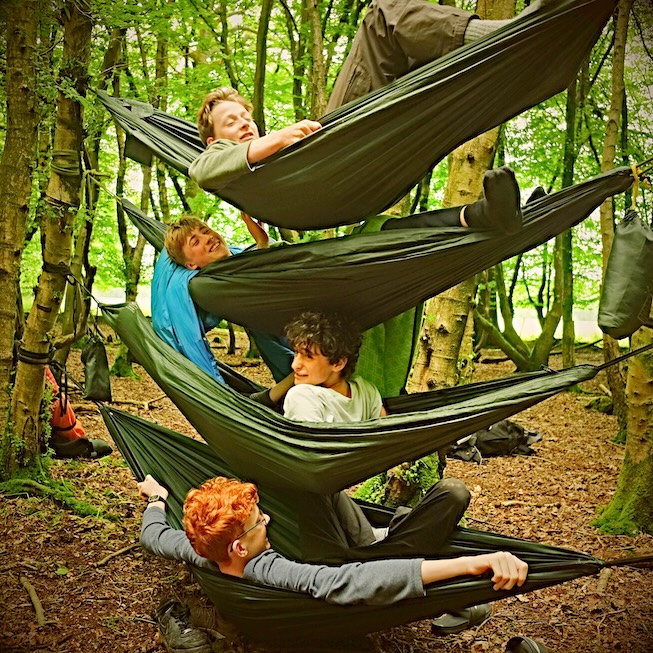
Alongside tasks, activities and games, I alternate with generous periods of no structure or direction.  And after a while, I notice how they begin to settle into this.  You can tell the shift is happening when the focus moves away from destruction and more towards construction: they ask if they can carve a spoon, they go off to make their own fire, or they see how many people can fit into a precarious quadruple-decker hammock setup they have created.

Unnecessary but fun structures arise when you remove unnecessary and tedious structure

Why teenage boys need boredom specifically

Adolescence brings restlessness, awkwardness, uncertainty, and social self-consciousness – truly the best days of our lives!  Boredom is often the space where boys learn to tolerate these feelings without escaping them immediately.

When boredom is constantly eliminated, something else fills the gap – usually distraction. Not because boys are weak, but because they’ve never had reason to develop an alternative.

Many boys know what Creative Mode feels like in a game – that open-ended state where they build and invent without being told what to do.  Real life has a very good version of this, but screens prevent the boredom that carries them there.

Boredom builds something important.  When boys sit in it long enough, they learn to tolerate discomfort without escaping it – and that tolerance is the foundation everything else rests on.  Focus, initiative, confidence: these can’t be taught directly.  They emerge from the other side of boredom.

This is particularly true on multi-day trips, where real life really has the opportunity to influence the experience.

Adults struggle with this too

Adults aren’t much better. We’re just as awkward with silence, and we’ve dressed our own screen dependency up in more respectable clothing: Important Messages, Vital Googling, Admin.

Teenagers are watching this constantly. If we treat every gap as something to fill, they will too.

Let boredom do its work

Boredom needs two things: time, and the absence of easy escape routes.

The outdoors provides both naturally. Screens are physically absent, with no obvious alternatives. And time stretches – which is how my generation spent entire summer holidays doing ‘nothing.’ Dads can harness this memory and relive it with their sons. It does wonders for the son, and for the father-son relationship, to get outdoors together.

The fire quest – fourteen hours alone in the dark tending a fire – is boredom in its most concentrated form. No phone, no watch, nothing to do except tend the fire and sit with what arrives. (Read about the fire quest here →)

Boredom is where agency begins. It’s the moment a teenager realises: I can do something with this. We don’t give that moment anything like the weight it deserves.

At home, it’s much harder, because screens are everywhere and habits are entrenched.  Lecturing boys about screens or attention won’t get the result we want as parents, it just leads to tantrums.  Energy is better spent on exposing him to constructive discomfort, and resisting the urge to rescue him from it… which is most effectively achieved outside.

Once they’ve discovered what lies on the other side of boredom – in the woods, away from screens – that knowledge comes home with them. It doesn’t solve everything, but it builds a healthy habit to counter the screen effect: to stay in the uncomfortable moment, knowing that it’s a place worth staying.

—-

If you want to experience this kind of environment directly, Feral Fathers runs woodland weekends for fathers and children (ages 8+) and wild camping expeditions in the hills (ages 12+).

You don’t need to be an outdoorsman. You just need to turn up and muck around.

Learn more about woodland weekends → 
Learn more about expeditions →

Email: cpacke@yahoo.co.uk | WhatsApp: 07940 272474

Why time in nature matters for fathers and sons – and how to make it happen

Fathers and sons often struggle to connect. Not from lack of compatibility, but lack of context – most modern life happens indoors, scheduled, distracted by screens.

Time in nature changes this.  Nature is not magical, but it offers important conditions more easily than indoor life: shared challenge, real consequences, space for boredom, situations to problem-solve together.

I’ve run woodland weekends for fathers and sons for over ten years. The same pattern happens every time: anxiety or awkwardness soften, competence emerges, connection deepens. No phones, no agenda, just time together doing real things

There’s plenty of research about how challenge, curiosity, and unstructured, screen-free time outdoors build confidence, resilience, and deeper family bonds.  But honestly, you don’t need the studies. You can feel it in the woods.

So why does this work so reliably? And how can ordinary fathers make it happen with their own sons – even if they’re not “outdoor types”?

Why our sons, in particular, need outdoor time

Physical challenge builds confidence

(Daughters, of course need outdoor time, with their dads, but in a different way that I have written about here)

Many teenage boys are wired for physical challenge and manageable risk. They need to test themselves, push limits, and discover what they can handle.

Modern life offers very few legitimate outlets for this.

School is mostly sitting still. Home is often screen-based. Even organised sport, which can be hugely valuable, is highly structured and supervised. The outcomes are usually known in advance.

Nature offers something different: problems where you don’t already know how it will go.

When a 13-year-old manages to light a fire in the rain, builds a shelter that actually keeps him dry, or navigates a few miles with a map and compass, that competence lands differently. It’s not theoretical, and it’s far from a digital achievement. It’s something he feels in his body.

The same, of course, is true for dads.

Natural consequences teach better than lectures

In the outdoors, consequences are immediate and impersonal.

If you don’t collect firewood, you’re cold. If your shelter leaks, you get wet. If you don’t purify water, you stay thirsty.

There’s no arguing with the wind.  We are in the arena of Type 2 Fun here: experiences that are hard, but deeply satisfying.

Boys respond to this reality better than they do to nagging or lectures from adults.

I’ve regularly seen boys who are described as “difficult” at home or school become focused, capable and cooperative in the woods. The environment demands responsibility, and they meet it.

Side-by-side connection works differently

Fathers and sons connect best side by side – walking, building a den, fixing something together.  Being face-to-face and expecting to “talk about feelings” is pretty unrealistic.

Most men already know this.  Nature just makes it easy: there’s always something to do, and conversation happens as a by-product.

One father once told me that he and his 14-year-old son woke up at dawn in the den they’d built and lay there for a couple of hours, listening to birdsong and watching the light change.

“That was the first time we’d hugged in over two years,” he said.

What a thing to hear from a dad – I shall never forget that.

Why nature changes the dynamic

Shared challenge levels the playing field

At home, fathers usually hold the expertise: they know how things work and they set the rules. The son is the learner.

In the woods, especially if neither of you is particularly experienced, that hierarchy softens. You’re both figuring things out in unfamiliar territory. You fail together and problem-solve together.

Sometimes the son teaches the father: a better knot, a smarter way to split kindling, a shortcut he’s found. So often, young lads are remarkably observant, and can spot a robin’s egg where dad just saw another tree.  That reversal matters more than we tend to realise.

Play matters a lot

One of the things boys consistently remember from Feral Fathers weekends is simply seeing their dad playing – winning, losing, laughing – not managing, teaching or supervising.

They’re shocked and delighted: “I didn’t know my dad could be silly.” Or: “I beat him at something and he loved it.”

Fathers performing competence all the time is exhausting for everyone.  Play gives permission to drop that.

Seriousness can seriously get in the way of people connecting.

The absence of screens changes everything

One of the biggest shifts happens simply because phones aren’t there.

At first there’s often a low-level restlessness: checking pockets, the impulse to photograph everything. Then something settles.

Boys start noticing things: sounds, smells, the feel of the sunshine on his face (or sometimes the rain – equally pleasant but less popular) .  The way a fire behaves. Eventually — and this is the gold standard – they get bored.

That might sound negative, but boredom is the doorway to creativity, presence and genuine engagement. Screens eliminate boredom instantly. Nature doesn’t: it tends to get you exploring and experimenting.  (We never quite manage to attain boredom on a Feral Fathers weekend though).

I could write a whole piece about this. The short version is that when escape routes disappear, something important comes back.

Making it happen without being an expert

The most common concern I hear from fathers is: “I wouldn’t know what I was doing.”

That’s fine. Your son doesn’t need you to be Ray Mears.  He just needs you to give it a go.

Start simple: a day walk to a clear destination – a hilltop, a lake, a landmark, or cook a meal outdoors (by ‘meal’ I mean sausages and marshmallows: that is a meal).  Or – a little more daring – sleep out for a night somewhere sensible and low-key (we call this a “micro-adventure”).

Give your son actual responsibility: let him navigate, light the fire, choose the route. Nature makes trust easy, and boys this age are desperate to be trusted and taken seriously by their dads.

Consistency matters more than ambition. A pattern of do-able trips builds the foundation. Then, when trust and capability are established, elaborate expeditions become possible – and magnificent (and here’s what I think of the benefits of multi-day expeditions).

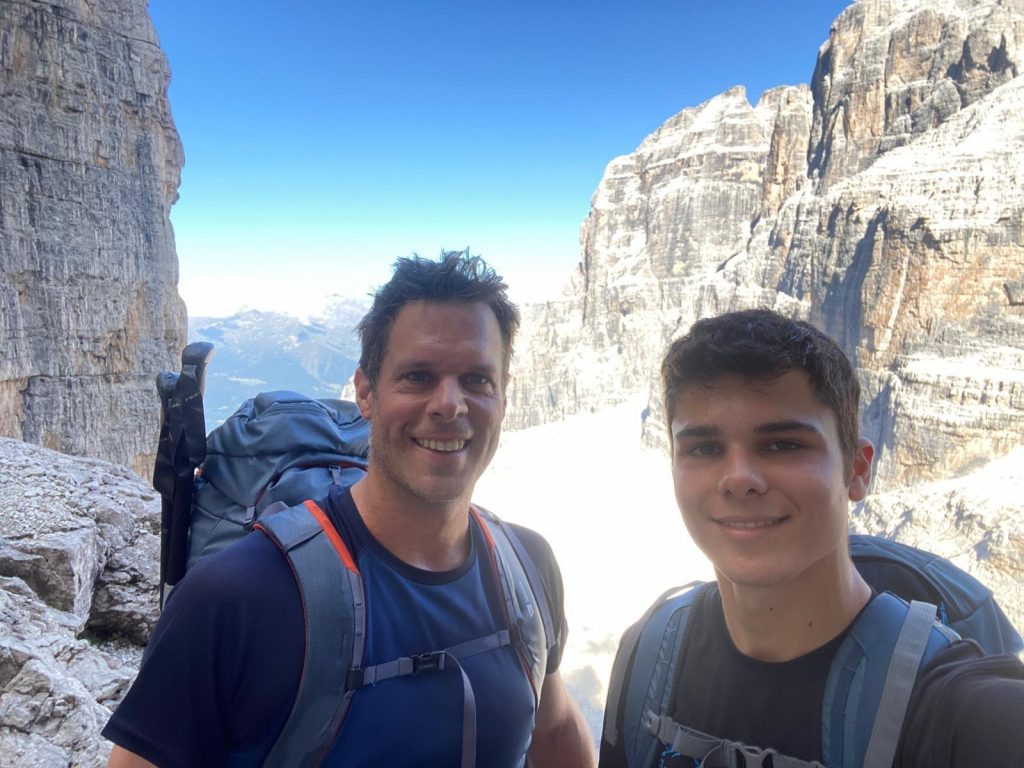
In the Dolomites climbing via ferrata with my son Finn… the best of times

There’s a window — and it doesn’t stay open forever

There’s a window for this – roughly ages 8 to 15. It doesn’t stay open forever.

If your son is in that space now, this matters. Not next year. Now.

It doesn’t have to be perfect

Getting things right is not the point.

Your son won’t remember whether the tarp was perfect or the fire lit first time. He’ll remember that you tried, that you were there, and that you worked it out together.

That’s what builds the bond… while nature – the outside kind and the inside kind – does the rest.

Where this leads next

There are three threads running through all of this that deserve more space:

—-

Experience this with your son

Feral Fathers runs woodland weekends (ages 8+) and multi-day expeditions (ages 12+) – small groups, no phones, real challenges.

Not instruction. Not entertainment. Just conditions where fathers and sons (or daughters!) discover what they’re capable of together.

Learn more about woodland weekends → 
Learn more about expeditions →

Email: cpacke@yahoo.co.uk | WhatsApp: 07940 272474