
Why time in nature matters for fathers and sons – and how to make it happen
Fathers and sons often struggle to connect. Not from lack of compatibility, but lack of context – most modern life happens indoors, scheduled, distracted by screens.
Time in nature changes this. Nature is not magical, but it offers important conditions more easily than indoor life: shared challenge, real consequences, space for boredom, situations to problem-solve together.
I’ve run woodland weekends for fathers and sons for over ten years. The same pattern happens every time: anxiety or awkwardness soften, competence emerges, connection deepens. No phones, no agenda, just time together doing real things
There’s plenty of research about how challenge, curiosity, and unstructured, screen-free time outdoors build confidence, resilience, and deeper family bonds. But honestly, you don’t need the studies. You can feel it in the woods.
So why does this work so reliably? And how can ordinary fathers make it happen with their own sons – even if they’re not “outdoor types”?
Why our sons, in particular, need outdoor time
Physical challenge builds confidence
(Daughters, of course need outdoor time, with their dads, but in a different way that I have written about here)
Many teenage boys are wired for physical challenge and manageable risk. They need to test themselves, push limits, and discover what they can handle.
Modern life offers very few legitimate outlets for this.
School is mostly sitting still. Home is often screen-based. Even organised sport, which can be hugely valuable, is highly structured and supervised. The outcomes are usually known in advance.
Nature offers something different: problems where you don’t already know how it will go.
When a 13-year-old manages to light a fire in the rain, builds a shelter that actually keeps him dry, or navigates a few miles with a map and compass, that competence lands differently. It’s not theoretical, and it’s far from a digital achievement. It’s something he feels in his body.
The same, of course, is true for dads.
Natural consequences teach better than lectures
In the outdoors, consequences are immediate and impersonal.
If you don’t collect firewood, you’re cold. If your shelter leaks, you get wet. If you don’t purify water, you stay thirsty.
There’s no arguing with the wind. We are in the arena of Type 2 Fun here: experiences that are hard, but deeply satisfying.
Boys respond to this reality better than they do to nagging or lectures from adults.
I’ve regularly seen boys who are described as “difficult” at home or school become focused, capable and cooperative in the woods. The environment demands responsibility, and they meet it.
Side-by-side connection works differently
Fathers and sons connect best side by side – walking, building a den, fixing something together. Being face-to-face and expecting to “talk about feelings” is pretty unrealistic.
Most men already know this. Nature just makes it easy: there’s always something to do, and conversation happens as a by-product.
One father once told me that he and his 14-year-old son woke up at dawn in the den they’d built and lay there for a couple of hours, listening to birdsong and watching the light change.
“That was the first time we’d hugged in over two years,” he said.
What a thing to hear from a dad – I shall never forget that.
Why nature changes the dynamic
Shared challenge levels the playing field
At home, fathers usually hold the expertise: they know how things work and they set the rules. The son is the learner.
In the woods, especially if neither of you is particularly experienced, that hierarchy softens. You’re both figuring things out in unfamiliar territory. You fail together and problem-solve together.
Sometimes the son teaches the father: a better knot, a smarter way to split kindling, a shortcut he’s found. So often, young lads are remarkably observant, and can spot a robin’s egg where dad just saw another tree. That reversal matters more than we tend to realise.
Play matters a lot
One of the things boys consistently remember from Feral Fathers weekends is simply seeing their dad playing – winning, losing, laughing – not managing, teaching or supervising.
They’re shocked and delighted: “I didn’t know my dad could be silly.” Or: “I beat him at something and he loved it.”
Fathers performing competence all the time is exhausting for everyone. Play gives permission to drop that.
Seriousness can seriously get in the way of people connecting.
The absence of screens changes everything
One of the biggest shifts happens simply because phones aren’t there.
At first there’s often a low-level restlessness: checking pockets, the impulse to photograph everything. Then something settles.
Boys start noticing things: sounds, smells, the feel of the sunshine on his face (or sometimes the rain – equally pleasant but less popular) . The way a fire behaves. Eventually — and this is the gold standard – they get bored.
That might sound negative, but boredom is the doorway to creativity, presence and genuine engagement. Screens eliminate boredom instantly. Nature doesn’t: it tends to get you exploring and experimenting. (We never quite manage to attain boredom on a Feral Fathers weekend though).
I could write a whole piece about this. The short version is that when escape routes disappear, something important comes back.
Making it happen without being an expert
The most common concern I hear from fathers is: “I wouldn’t know what I was doing.”
That’s fine. Your son doesn’t need you to be Ray Mears. He just needs you to give it a go.
Start simple: a day walk to a clear destination – a hilltop, a lake, a landmark, or cook a meal outdoors (by ‘meal’ I mean sausages and marshmallows: that is a meal). Or – a little more daring – sleep out for a night somewhere sensible and low-key (we call this a “micro-adventure”).
Give your son actual responsibility: let him navigate, light the fire, choose the route. Nature makes trust easy, and boys this age are desperate to be trusted and taken seriously by their dads.
Consistency matters more than ambition. A pattern of do-able trips builds the foundation. Then, when trust and capability are established, elaborate expeditions become possible – and magnificent (and here’s what I think of the benefits of multi-day expeditions).
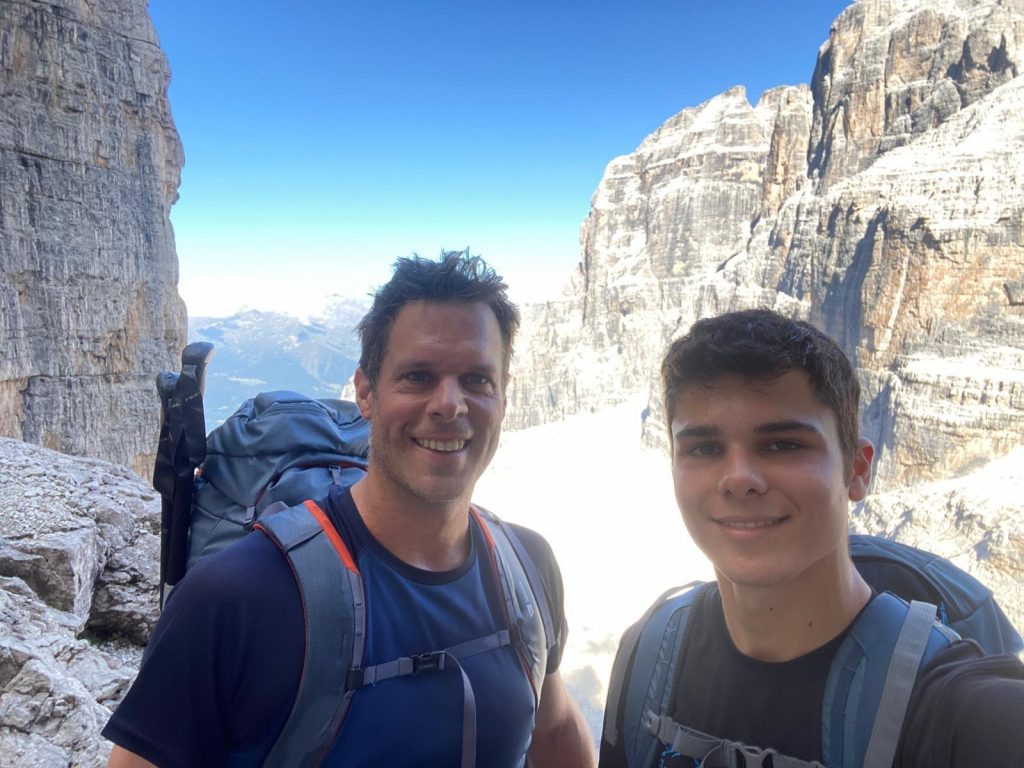
There’s a window — and it doesn’t stay open forever
There’s a window for this – roughly ages 8 to 15. It doesn’t stay open forever.
If your son is in that space now, this matters. Not next year. Now.
It doesn’t have to be perfect
Getting things right is not the point.
Your son won’t remember whether the tarp was perfect or the fire lit first time. He’ll remember that you tried, that you were there, and that you worked it out together.
That’s what builds the bond… while nature – the outside kind and the inside kind – does the rest.
Where this leads next
There are three threads running through all of this that deserve more space:
- – Why teenage boys need boredom
- – Why timing matters so much in father-son relationships
- – How fathers can make outdoor time happen with children, without being an expert
—-
Experience this with your son
Feral Fathers runs woodland weekends (ages 8+) and multi-day expeditions (ages 12+) – small groups, no phones, real challenges.
Not instruction. Not entertainment. Just conditions where fathers and sons (or daughters!) discover what they’re capable of together.
Learn more about woodland weekends →
Learn more about expeditions →
Email: cpacke@yahoo.co.uk | WhatsApp: 07940 272474