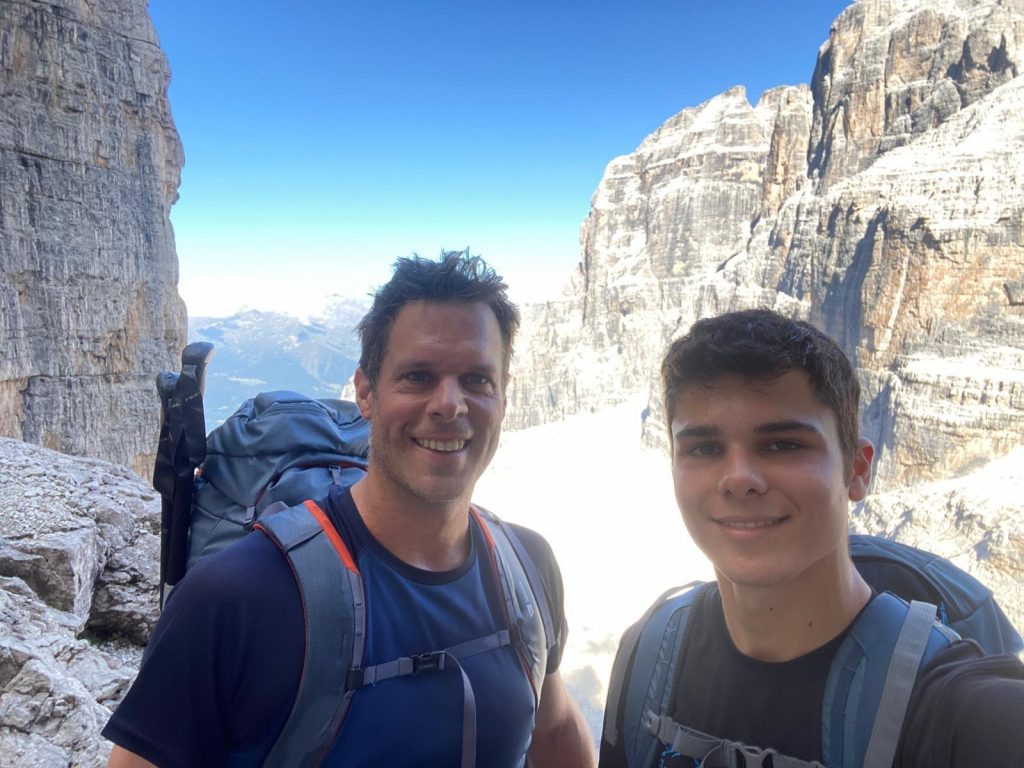
The father–son relationship window: why ages 8–15 matter most
There’s a period in a boy’s life when the father-son relationship carries unusual weight.
It’s not infancy, when care is everything. This is the realm of motherhood, where dads serve best by serving the mother. And it’s not late adolescence, when peers, independence, and privacy will often dominate.
It’s the stretch in between – roughly ages 8 to 15 – when a subtle shift is underway that isn’t obvious yet, even to them; their inner world is reconfiguring.
Boys are no longer children… and they’re not yet young men… but their centre of gravity is beginning to move out from the safety of the home, and into the dangerous world: this is now the realm of fatherhood.
And during this window, fathers matter in an incredibly important way.
What’s actually changing between 8 and 15
Around this age, many boys begin to shift their attention outward (at differing rates – slower if they have lots of escape routes to avoid real life).
They become more interested in gaining competence, testing their limits (especially physically) and seeking belonging beyond the immediate family.
They usually won’t articulate any of this (or anything much really). Often it shows up as friction: restlessness, criticism of their parents, selective withdrawal. And a decent bit of “peacocking”. Even though it can be jarring to parents, I love seeing this happen. It’s a signal – not that there’s a problem to be fixed, but that there’s a developmental transition underway… and an absolutely beautiful one.
The boy is beginning to ask, consciously or not: What kind of person am I becoming, and how do I find my place? And – brace yourself – Who will show me how to be a man?
These are earth-shattering questions. And Dads: it is our honour and privilege to be their primary guide in this.
Why fathers become vital in this phase
During early childhood, a father’s role is largely about presence, safety, and play. The Procreation role is clearly fulfilled, and attention is often around the masculine roles of Protecting and Providing – keeping the lights on and danger at bay – which are still as relevant as ever for men.
The call to motherhood is pretty clear: it is biological, obvious, and so it is well understood. The call to fatherhood, however, is not so obvious. No-one taps you on the shoulder and says, “now”. It is even possible to think that the father’s contribution might stop after the Procreation stage, that having a father around is optional.
No. Both roles deserve to be understood. But fatherhood’s lack of clarity means it needs more conscious attention – especially during this window, when it becomes the most important thing.
Guiding boys through a change in orientation
In the book Iron John, Robert Bly tells of a boy who steals the key to the wild man’s cage from under his mother’s pillow. The boy can’t free the wild man while staying under the mother’s protection. He has to leave safety to access wildness.
That’s what’s happening between 8 and 15. Boys aren’t rejecting home – they’re outgrowing it. The restlessness, the friction, the need to test limits: this is the key being stolen.
Boys enter a phase where it no longer appropriate for them to be kept close. They become independent enough to be watching how a man moves through the world, and Dad is the First Man.
The boy is looking at how a man handles difficulty, courts risk, responds to uncertainty, engages with effort, manages and extends his own limits.
Fatherhood becomes about helping the boy begin facing, and exploring, the world beyond the home, with all its toil and teeth and temptation. The role here is less about shaping outcomes, and more about setting the stage for his journey into the world. It’s not about initiating a boy into manhood at 12, but helping him build the internal foundations that make that transition possible later.
That maturing happens primarily through shared experience, not instruction. Expertise is not needed.
Why nature plays a crucial supporting role
Conversation is generally not used as a method of communication between men and boys as often as in most other relationships, so it’s usually about doing rather than talking.
Boys thrive off experiences that require effort and involve challenge, that are risky and uncertain, and that involve choices that matter. They also need a sense that things don’t revolve around them (as much as they might furiously peacock).
That’s quite a list, but the outdoors delivers it effortlessly. Nature is hugely beneficial to fathers and sons. This makes sense, because this is the environment that shaped us into the human beings we now are – physically, emotionally, spiritually, all the ways you might come up with.
Out in nature, neither father nor son is fully in charge. Weather, terrain, fatigue, and time all have a say, and don’t accept the excuses that work indoors. Plus, there are just so many cool things to do.
That changes the relationship: the father doesn’t have to be the entertainer or problem-solver, and the son isn’t the consumer of attention. This shared engagement, inside the awesome and mysterious container of nature, creates conditions that are hard to reproduce elsewhere.
(It is worth noting that the father doesn’t always need to be present – sometimes the role is to send the child out into experiences on their own, and support from a distance. A good example of a formative nature experience that fathers play an important role in ‘sponsoring’ is the fire quest, which lands particularly well in the 12-15 age range, and I write about here →.)
What happens if the window is missed
With no obvious call to action, this ‘window’ can be missed, and it’s possible that no-one notices the loss… but something is lost.
I suspect what makes this omission possible is that, in my view, fatherhood is less understood and therefore less celebrated than motherhood. They deserve to be on an equal footing, equally critical, but with their importance peaking at different times. When absence from home (for work, or through separation) is seen as quite normal, fathers should not be blamed for ‘missing the call’.
But without enough father energy during this phase, boys often turn almost entirely to peers, or online spaces. These can offer belonging and even inspiration – but they can’t offer what a father can: a real, embodied, present guide who knows them.
Once the window begins to close, influence becomes harder to offer directly. The relationship can still deepen – but the leverage point has passed.
Why this matters
Between 8 and 15, boys are assembling an internal map. Even though they don’t consciously know it, they are asking important questions. What am I capable of? What do I do with my energy? Do I belong – and to what? What kind of man am I becoming? Who really sees me?
Girls have menstruation to provide a physical and mythological frame for their deep changes, as women have pregnancy and childbirth. Boys have no equivalent marker for their transition – no physical signal that something fundamental is changing. The shift for boys is less obvious, which is why it can be missed – by fathers and by boys themselves. But it’s happening, and it needs attention.
They need a mentor, a guide, to take them places they can’t go by themselves, and to share experiences where those important questions can be explored, so their maturity can blossom, eventually into full grown men in every sense.
Recognising this, and responding to it, is one of the most important moments of fatherhood there is. It is a coming of age for us too.
—-
This is what Feral Fathers weekends and expeditions are built around: the 8-15 window, when fathers and sons (and daughters) can build something that matters.
Weekend camps in Sussex woodland (ages 8+). Multi-day expeditions in the hills (ages 12+). Small groups, no phones, lots of fun.
Learn more about woodland weekends →
Learn more about expeditions →
Email: cpacke@yahoo.co.uk | WhatsApp: 07940 272474