
outdoor experiences

Social media isn’t the problem (and neither is sugar or fast food)

It’s reassuring to have a villain.

At the moment, one of the big ones is social media (which I have written about specifically in a separate post). There are plenty of others: sugar, fossil fuel companies, the education system, fast food, video games.

The pattern is familiar. We identify an external force, blame it for our problems, and demand someone regulate it.  Surely now things will improve.

Except they rarely do, because we tend to look in the wrong direction.

I recognise this pattern because I fall into it myself – I do love to equip myself with a good oversimplification.

The social media ban as a microcosm

The UK is considering following Australia in banning social media for under-16s.  Many parents feel relieved, and politicians look like they’re “doing something” about youth mental health.

But the story underneath it sounds like: “Social media does this to us.”

Rather than: “We’re making choices that are harming us.”

The phone becomes the agent. I become the passive recipient.

That framing is backwards.

The bits we often skip over

A few things can be true at the same time: social media companies do design highly compelling products… those products do exploit psychological vulnerabilities… and teenagers do struggle with self-regulation.  All true.

But there are also some truths we tend to leave out.  Many of us haven’t developed much tolerance for boredom or discomfort, so we often reach for distraction automatically.  We might inadvertently seek to fill every spare moment with something.  When it comes to phones, we are modelling our own phone habits constantly, whether we intend to or not.

None of this makes us bad people. It makes us human, living in a particular environment.  But if we refuse to acknowledge our side of the equation, banning platforms starts to look like wishful thinking.

Why external blame is so appealing

The “ban it” approach is attractive because it feels clean and decisive.  It also relieves us from looking at our own habits.  If the problem lives out there, I don’t have to look too closely at what I do, what I model, what I avoid.

It’s much easier to say: “These platforms are predatory – we’re victims,” than it is to admit that I struggle with discipline, I don’t always enforce boundaries because it’s tiring, I use screens for relief and convenience and I avoid boredom as much as my kids do.

The external blame route has become very normal.  There’s much less talk of personal responsibility or life skills, and even less modelling of them by adults.

This pattern isn’t unique to social media

Social media is just the most recent example of a broader cultural habit: locating problems entirely in systems and institutions, while quietly ignoring our own participation in them.

You can see it everywhere.

“The food industry makes us unhealthy.” True, but so do the choices we make at the supermarket.

“Corporations are destroying the planet.”  Yes.  But what about the daily choices we make that prioritise ease and consumption?

The external factors are real, but it isn’t the root cause – it’s the part that allows us to look away from ourselves.

Accountability isn’t about blame or shame. It’s about noticing where agency still exists, even in imperfect systems.

It’s uncomfortable, because it means admitting: yes, the world makes bad choices easy. And yes, I still have agency within that. And yes, using it requires effort, with no villain to absorb the blame when I fall short.

Which is precisely why externalising is so tempting.

Why this matters beyond social media

Even if a social media ban passes, and even if it helps a little, the underlying pattern remains.

If we don’t address our tendency to avoid responsibility and discomfort, nothing fundamental changes. We’ll regulate one thing, then move on to the next distraction, the next convenience, the next villain.

Because the real issue isn’t the availability of temptation, in practice it’s our limited capacity to resist it.  That capacity is internal, and no policy can build it for us.  But – and this matters – capacity doesn’t develop in a vacuum. Environments either support it or undermine it.  Which is why where we spend time matters as much as what we decide.

Environments shape behaviour

The environments we’re in have a huge influence on how we behave. Going against the grain of our surroundings is genuinely difficult.

That’s why environments that support agency matter so much — environments where distractions are reduced, discomfort can’t be avoided, choices have real consequences, and effort leads to tangible outcomes.

Outdoor settings do this naturally. With no phone signal, no central heating, and no instant entertainment, you’re forced to respond to what’s actually in front of you. You discover, often to your surprise, that you’re more capable than you thought (especially on multi-day experiences, where you get to reap the delayed rewards of Type 2 Fun).

The same principles can apply at home, too, if we’re willing to design for them.

But they all require something uncomfortable: actively taking responsibility.

The pattern continues

Ban sugar advertising. Remove smartphones from schools. Ban social media.

Some of these measures may be justified. External factors matter.  But they’re not the root.

Until we’re willing to rebuild our capacity for discipline, discomfort, and delayed gratification – and to model that to our children – we’ll keep searching for new things to ban while making the same choices that brought us here.

—-

About Feral Fathers

The weekends I run take place in the woods, where phones don’t feature, comfort isn’t guaranteed… and agency tends to emerge.

Feral Fathers runs lively weekend camps for fathers and children in Sussex woodland (for ages 8+) and multi-day expeditions in the hills (ages 12+).

Learn more about woodland weekends → 
Learn more about expeditions →

Email: cpacke@yahoo.co.uk | WhatsApp: 07940 272474
Why banning social media for under-16s won’t fix “teen screen addiction” (and what actually helps)

Australia’s done it, and it looks like the UK might follow: banning some of the major social media platforms for under-16s.

Many parents feel relief that the thing they believe is wrecking attention, mental health, and even basic conversation might finally be addressed.

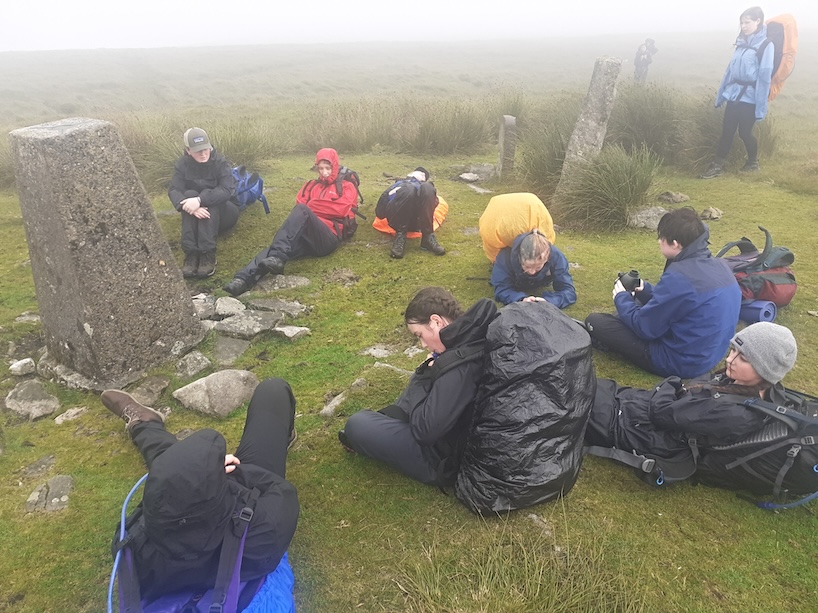
I understand the relief.  Over the last decade I’ve brought countless groups of teenagers into the woods on expeditions and outdoor events. When I speak to parents beforehand, they often describe what they’re seeing as “screen addiction.”  I’m not convinced that’s quite the right word – but it does point to something real.

And it’s not just the parents who feel relief. On these events I’ve noticed a consistent pattern when teenagers walk away from their phones: a visible unwinding.  Nervous energy settles. Many clearly appreciate being phone-free for more than 48 hours.

I’ve also noticed how quickly the phones come back out the moment they get into the car at pickup.

So – a social media ban. OK.

The problem is a familiar one, so allow me a cliché: the ban treats the symptom, not the cause.

What a social media ban might actually do

Restricting social media is probably a worthwhile move.

Tech companies design powerful platforms that are engaging, frictionless, and endlessly novel – that is literally what they exist to do. Teenagers aren’t yet equipped to regulate something that powerful, yet we gave them unrestricted access and were shocked at the problems that emerged.

If the ban is implemented in a way that teenagers don’t immediately bypass (a big assumption), it may create some useful space. Less comparison. Less cyberbullying. Less exposure to genuinely strange and harmful content.  Any clear boundary would be a positive outcome.

But the impact is likely to be limited.

After a ban, many teenagers would still struggle to sit with boredom (the importance of which I have written in a specific post here). They’d still have a low tolerance for difficulty or uncertainty (the importance of hardship I have written about in a post here). And so they’d still reach for distraction the moment something felt uncomfortable.  As far as I can tell, many smartphone-era teenagers haven’t learned what to do with themselves when there’s nothing to do.

And if we’re honest, many adults have forgotten too.

The real addiction: escaping discomfort

Nir Eyal, who researches distraction and wrote Indistractable, makes a crucial point: we don’t get distracted by our devices — we get distracted away from discomfort.  The device is just the escape route.

Teenagers aren’t on social media so much simply because the apps are compelling. They’re constantly there because the apps offer immediate relief from uncomfortable feelings: boredom, loneliness, anxiety, awkwardness, uncertainty.

Those feelings are normal human experiences. Social media didn’t create them – it just became the fastest way to avoid feeling them.  Take the phone away, and the feelings don’t magically disappear. Without new skills, teenagers will simply find the next available escape – whatever is still allowed.

This continues until they learn how to stay present with discomfort without immediately numbing or avoiding it.

How we created the vulnerability

We’ve built a world where discomfort has been steadily engineered out of teenage life.  The house is never too hot or cold.  Boredom is treated as a problem to be solved within seconds.  Physical challenge is limited, so teenagers rarely discover what they’re capable of handling.  Free roaming has shrunk, meaningful risks have diminished, and weekends are scheduled so tightly there’s little room to figure out what to do with themselves.

None of this is malicious. It’s convenience, safety, good intentions – layered over decades. But the result is that external discomfort has been removed almost entirely. And then we handed them a device that provides instant relief from internal discomfort.

Are we really surprised they struggle to put it down?

Why the outdoors helps so much

Outdoor environments remove escape routes and reintroduce manageable discomfort – all at once.

Bored? There’s no phone. But there’s a fire to watch, and it doesn’t look like much until you’ve watched it for a while. Cold? You can’t turn up the heating, but you have that fire, so add a log, add layers, move around.  Tired?  There’s work that still needs doing – shelter, food, water – but you’ll sleep well afterwards.  Socially awkward?  You can’t disappear into a screen, but sitting quietly is also fine.

Outdoors, teenagers can rebuild a skill modern life has made much harder to develop: tolerance for discomfort. Boredom, uncertainty, physical challenge, difficult feelings – all survivable, all developmental, all temporary.  Generally, from what I’m told directly by teenagers, they lead to “the best time ever” (especially on multi-day trips, which have huge benefits that I talk about here).

But you can’t learn any of this with a constant escape route in your pocket.

What parents still need to do after a ban

After a ban, parents would still have real work to do.

Actively teaching tolerance for discomfort matters – modelling it, setting boundaries, resisting the urge to rescue.  But the most effective approach has always been experiential: giving teenagers environments where they learn these skills themselves, through doing rather than being told.

That includes:

  • Unstructured time: no screens, no organised activities.
  • Physical challenge: hiking, camping, building things, long days outdoors.
  • No immediate escapes: phone-free meals, journeys, weekends – for adults too.
  • Room to struggle: resist rescuing them from every hard moment.

Most important of all is modelling. If we reach for our phones at every awkward silence or dull moment, we teach them that discomfort should be avoided.

There’s harder work to be done than banning things

The social media debate is a useful step, but it isn’t a solution. It’s part of a wider pattern of only looking for external forces to blame, while not also looking to individual behaviour and accountability, which I write about here.

The real question is: what do we do with the space a ban creates?

Do we fill it with different screens and distractions, or do we help teenagers rediscover boredom, uncertainty, effort, and the quiet confidence that comes from handling them?

That work can’t be outsourced to policy.  It requires parents to tolerate our own discomfort too: watching our children struggle, stepping back, and – perhaps hardest of all – putting our own phones down.

—-

About Feral Fathers

This is what happens on our weekends – no phones, no distractions, no escape routes.  Just time in the woods mucking around in a feisty tribe.

Feral Fathers runs lively weekend camps for fathers and children in Sussex woodland (for ages 8+) and multi-day expeditions in the hills (ages 12+).

Learn more about woodland weekends → 
Learn more about expeditions →

Email: cpacke@yahoo.co.uk | WhatsApp: 07940 272474
Why daughters need their dads in the wilderness

Your daughter is strong. Stronger than the world tells her she is.

After around age 10, something shifts, in a way that is often challenging for dads. Girls begin navigating an increasingly complicated landscape: friendships become charged with social risk, bodies change in ways that feel public, and the pressure to be perfect, pretty, and pleasing intensifies.

And often, right when she needs you most, you might find yourself pulling back.

Not consciously or deliberately; I experienced it in the beginning with my daughter as a sort of involuntary recoil, which felt very jarring in the moment.

Adolescence makes many fathers uncomfortable around their daughters – that is definitely a thing.  The easy physical closeness of childhood can become awkward, sometimes quite suddenly.  You’re not sure how to be anymore, so you step back, assuming she needs space or preferring her mother handle “girl stuff.”

Research shows this retreat happens consistently across cultures. Psychologist Lisa Damour calls it one of the great losses of adolescence – not for the daughter alone, but for both of you. I have written how there is an important window not to be missed for fathers and sons, and it is true for daughters too.

But there’s a way to stay close that navigates the awkwardness very effectively: take her into the wilderness.

Why fathers often retreat (and what that costs)

Puberty changes things for fathers and daughters in ways it doesn’t for fathers and sons.

Many fathers report feeling suddenly uncertain – your daughter’s body is changing, social dynamics are confusing, and the easy physicality of childhood (wrestling, carrying her on your shoulders) no longer feels appropriate.  There is so much baggage around men and girls in our culture.  The fear of being seen as inappropriate – even predatory – around a developing girl keeps many fathers at arm’s length.  It shouldn’t, but it does.

So you default to distance.  You let her mother handle the “complicated stuff.”  You focus on being the provider, the problem-solver from a distance, the one who doesn’t make things more awkward by trying too hard.  This clear step back can happen at precisely the time when fatherhood becomes most vital.

Mary Pipher, in Reviving Ophelia, describes what this retreat costs: daughters lose access to the adult who could show them that women are strong people who do hard things, not just people who look a certain way and manage social approval.

Rachel Simmons’ research on teenage girls found that fathers staying engaged – physically active together, taking daughters seriously, treating them as capable – directly protects against a confidence collapse many girls experience in adolescence.

The wilderness solves the awkwardness problem because you’re not facing each other trying to “connect.”  You’re both facing outward toward a shared task: navigating to camp, building a fire, setting up shelter, figuring out where you are.

There’s something to do, something real.  The focus isn’t on each other – it’s on the work in front of you.

And that makes staying close possible, even easy, precisely when your relationship might otherwise become strained.

What your daughter is learning about her body (and why it matters what you show her)

There are powerful cultural narratives aimed at teenage girls about their bodies.  Expressed bluntly:

Your body is for other people to look at and evaluate.
Your worth is determined by how you appear.
Your body is decoration, not a tool.
Being pretty matters more than being strong.

Peggy Orenstein’s research in Girls & Sex found that when girls describe their own bodies, they overwhelmingly use appearance-based language. Very few describe their bodies as sources of strength, capability, or power, unless they have been specifically encouraged to do so.

The wilderness reverses this completely. Time outdoors, as I have written, matters for fathers and sons. It matters to for fathers and daughters, but in a different way.

In the woods, your daughter’s body isn’t something to be looked at – it’s something she uses.

Climbing, carrying, building, hiking.  She solves problems that require physical engagement.  Her body becomes clearly and unmistakably a tool, not an object.

When a girl discovers she can handle what the wilderness throws at her, she learns a lesson that runs counter to some of the loudest cultural messages.

Girls who develop physical competence — through sport, outdoor challenge, or hands-on work — consistently show higher self-esteem, stronger body image, and greater resilience to peer pressure and cultural messaging. Later in life, this competence often shapes how they approach intimacy and relationships.

My daughter once told me that the way I treated her as a teenager shaped the level of respect she now expects from a partner.  This insight was profoundly moving, and one I could never have planned, only hoped to support.

So, this isn’t just about “building confidence.”  It’s about fathers playing a fundamental role in how daughters see their own bodies and their relationships.

When fathers stay engaged through adolescence, daughters learn something about how men can be.  They don’t have to guess.

Why “Dangerous Daughters” matters

I have run weekends called “Feral Fathers, Dangerous Daughters” since 2019, and it is named that way deliberately.

Not because we’re doing objectively dangerous things (though we do take manageable risks).  It’s because “dangerous” goes against something culture tells girls they’re not allowed to be.

Rachel Simmons describes the “curse of the good girl” – the expectation that girls should be nice, well-behaved, perfect and pleasing.  But the wilderness has no interest in any of this.

You can’t be “nice” to a fire that won’t start – you have to problem-solve. You can’t stay clean and pretty when there is no shower or mirror, and when no-one cares how you look. You can’t be quiet and small when you are chasing someone else’s dad through the trees.

The wilderness requires girls to be loud, messy, direct, and assertive.  Not performing femininity, just being a person solving problems.

See – it’s not unfair for me to have thought they looked bedraggled

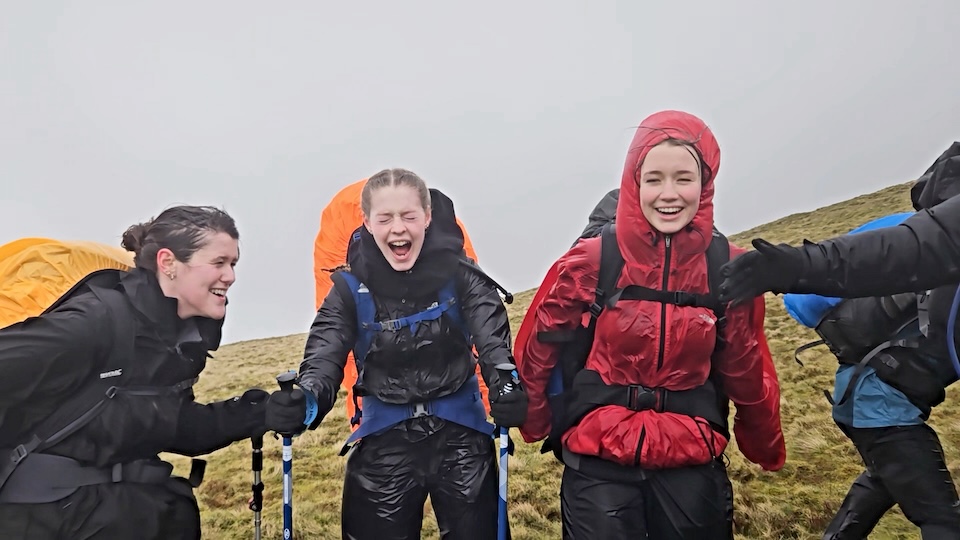
I was with a group of 15 year-old girls on an expedition in Dartmoor, and for a period of four hours on the moor, the weather was absolutely filthy.  I was a bit concerned that the wind and rain might put them off.  On the face of it, they looked so tired and bedraggled.

Later that evening, when the elements had eased and they were cooking their meal ahead of the night wild camping by the River Dart, one of them said: “I’ve done a lot of outdoor stuff with craft and circle time, and that’s fine, but what I really love is to get smashed in the face by a storm.”  To my delight, the entire group agreed, as they tucked into the chorizo and pasta chicken soup they had made.  The next spring, they were happily in the mountains of the Lake District, getting another “storm facial”. They learnt first hand the benefits of getting properly away on multi-day expeditions.

“Dangerous” means: skilful, assertive, and tough.  Shouting back at storms.

It means reclaiming what girls are so often told to suppress.  But something unexpected happens for the fathers too…

I do mean literally shouting back at a storm

It’s not just the daughters who grow

When fathers reflect on time in the wilderness with their daughters, what surprises them most is not what the girls gained – but what it gave them back.

“My daughter and I had a magical time… and bonding on a level I am not sure it is really possible to do in our everyday lives. It was quite strange re-entering civilisation.  Never again will I tell her to be careful with a sharp knife in the kitchen!” (David)

“That weekend felt like some of the most precious time we’ll ever spend together. I learnt so much about her that I don’t think I would’ve learnt any other way.” (Rick)

A storm in her face helps her face anything

The storm raged around us, the rain lashing and the wind howling.  And yet, in the middle of it, the girls were alive, surefooted, and unafraid… and I felt it too. They were shouting, laughing, and experiencing a freedom the world often tells them they shouldn’t have.

That day, they learned something bigger than any skill: they learned that they can face the elements, and life, head-on.

This is what remaining connected can look like – not smoothing the weather, but standing close while she meets it.

The best lessons aren’t taught, they’re lived.  So take your daughter into the storm.  Let her shout at it, hair everywhere – and let yourself rediscover the wildness of being a father along the way.

—-

Feral Fathers runs Dangerous Daughters weekends specifically for fathers and daughters (ages 8+) in Sussex woodland, along with mixed family weekends and multi-day hill expeditions (ages 12+).

Small groups, no phones, lots of fun and freedom.

Learn more about woodland weekends → 
Learn more about expeditions →

Email: cpacke@yahoo.co.uk | WhatsApp: 07940 272474
Why teenage boys need boredom (and how screens prevent it)

Boredom has a terrible reputation.

We treat it as a problem to be solved, a sign that something is wrong, or that we’ve failed to provide enough stimulation. If a teenage boy is bored, our instinct is to fix it quickly.

And now we can… instantly… infinitely!  A few taps and boredom disappears.

From my experience working with teenage boys outdoors over the last decade, I’ve come to think this is one of the most significant but under-the-radar problems we’ve created.

Not because boredom is harmful, but because it’s essential, and we’ve almost completely removed it from boys’ lives.

What boredom actually is

Boredom isn’t a sign that something has gone wrong. It’s the uncomfortable feeling that arrives when nothing is demanding your attention – and it used to be one of the most productive states a teenager could find themselves in.

If you don’t rush in to fix it, boredom usually starts doing something valuable.  Anyone who grew up before constant screens will recognise this.  Boredom led to dens, daft games, tinkering, wandering, arguing, inventing things, staring out of windows (I said “valuable”, not “productive”!)

It was the doorway into engagement – not something to be eliminated.

How screens change the equation

Screens short-circuit boredom completely.

They offer constant stimulation and novelty with zero effort, instantly erasing the small gaps where boredom might otherwise do its work.  There’s no need to sit with the uncomfortable gap where something might emerge: the moment boredom appears, it’s gone.

The issue isn’t that screens are evil or uniquely powerful, it’s that they are always available, and they remove the pause where something internal might develop.

Over time, boys don’t learn what boredom turns into — because they never stay in it long enough to find out.

What I see when screens are removed

In the first few hours of a phone-free outdoor weekend, there’s often a low-level restlessness.

It often manifests as walking around, hitting a tree with a stick, which I happen to think is an excellent way to pass the time.  I once found the Chairman of Pret a Manger and Itsu doing just this in my woodland, ten minutes after arriving.

The fire has leaf litter chucked in it a lot at first, and there’s a lot of talk about gaming. Then something shifts.

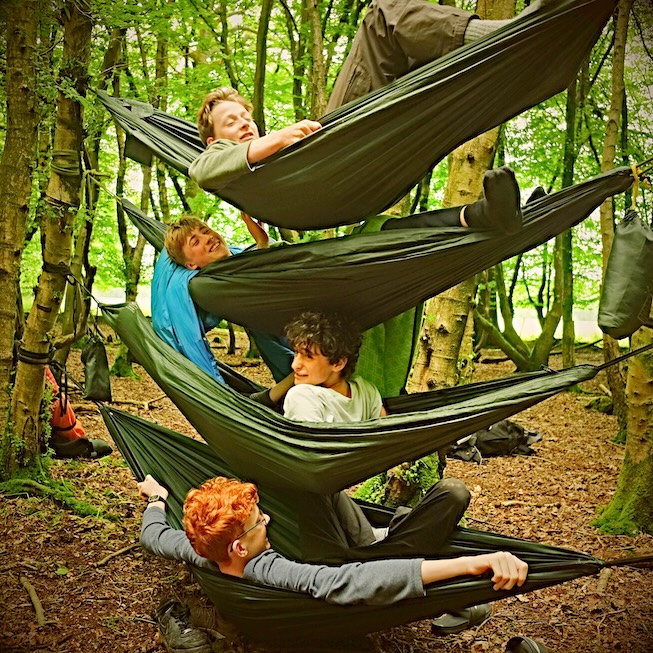
Alongside tasks, activities and games, I alternate with generous periods of no structure or direction.  And after a while, I notice how they begin to settle into this.  You can tell the shift is happening when the focus moves away from destruction and more towards construction: they ask if they can carve a spoon, they go off to make their own fire, or they see how many people can fit into a precarious quadruple-decker hammock setup they have created.

Unnecessary but fun structures arise when you remove unnecessary and tedious structure

Why teenage boys need boredom specifically

Adolescence brings restlessness, awkwardness, uncertainty, and social self-consciousness – truly the best days of our lives!  Boredom is often the space where boys learn to tolerate these feelings without escaping them immediately.

When boredom is constantly eliminated, something else fills the gap – usually distraction. Not because boys are weak, but because they’ve never had reason to develop an alternative.

Many boys know what Creative Mode feels like in a game – that open-ended state where they build and invent without being told what to do.  Real life has a very good version of this, but screens prevent the boredom that carries them there.

Boredom builds something important.  When boys sit in it long enough, they learn to tolerate discomfort without escaping it – and that tolerance is the foundation everything else rests on.  Focus, initiative, confidence: these can’t be taught directly.  They emerge from the other side of boredom.

This is particularly true on multi-day trips, where real life really has the opportunity to influence the experience.

Adults struggle with this too

Adults aren’t much better. We’re just as awkward with silence, and we’ve dressed our own screen dependency up in more respectable clothing: Important Messages, Vital Googling, Admin.

Teenagers are watching this constantly. If we treat every gap as something to fill, they will too.

Let boredom do its work

Boredom needs two things: time, and the absence of easy escape routes.

The outdoors provides both naturally. Screens are physically absent, with no obvious alternatives. And time stretches – which is how my generation spent entire summer holidays doing ‘nothing.’ Dads can harness this memory and relive it with their sons. It does wonders for the son, and for the father-son relationship, to get outdoors together.

The fire quest – fourteen hours alone in the dark tending a fire – is boredom in its most concentrated form. No phone, no watch, nothing to do except tend the fire and sit with what arrives. (Read about the fire quest here →)

Boredom is where agency begins. It’s the moment a teenager realises: I can do something with this. We don’t give that moment anything like the weight it deserves.

At home, it’s much harder, because screens are everywhere and habits are entrenched.  Lecturing boys about screens or attention won’t get the result we want as parents, it just leads to tantrums.  Energy is better spent on exposing him to constructive discomfort, and resisting the urge to rescue him from it… which is most effectively achieved outside.

Once they’ve discovered what lies on the other side of boredom – in the woods, away from screens – that knowledge comes home with them. It doesn’t solve everything, but it builds a healthy habit to counter the screen effect: to stay in the uncomfortable moment, knowing that it’s a place worth staying.

—-

If you want to experience this kind of environment directly, Feral Fathers runs woodland weekends for fathers and children (ages 8+) and wild camping expeditions in the hills (ages 12+).

You don’t need to be an outdoorsman. You just need to turn up and muck around.

Learn more about woodland weekends → 
Learn more about expeditions →

Email: cpacke@yahoo.co.uk | WhatsApp: 07940 272474