Why banning social media for under-16s won’t fix “teen screen addiction” (and what actually helps)
Australia’s done it, and it looks like the UK might follow: banning some of the major social media platforms for under-16s.
Many parents feel relief that the thing they believe is wrecking attention, mental health, and even basic conversation might finally be addressed.
I understand the relief. Over the last decade I’ve brought countless groups of teenagers into the woods on expeditions and outdoor events. When I speak to parents beforehand, they often describe what they’re seeing as “screen addiction.” I’m not convinced that’s quite the right word – but it does point to something real.
And it’s not just the parents who feel relief. On these events I’ve noticed a consistent pattern when teenagers walk away from their phones: a visible unwinding. Nervous energy settles. Many clearly appreciate being phone-free for more than 48 hours.
I’ve also noticed how quickly the phones come back out the moment they get into the car at pickup.
So – a social media ban. OK.
The problem is a familiar one, so allow me a cliché: the ban treats the symptom, not the cause.
What a social media ban might actually do
Restricting social media is probably a worthwhile move.
Tech companies design powerful platforms that are engaging, frictionless, and endlessly novel – that is literally what they exist to do. Teenagers aren’t yet equipped to regulate something that powerful, yet we gave them unrestricted access and were shocked at the problems that emerged.
If the ban is implemented in a way that teenagers don’t immediately bypass (a big assumption), it may create some useful space. Less comparison. Less cyberbullying. Less exposure to genuinely strange and harmful content. Any clear boundary would be a positive outcome.
But the impact is likely to be limited.
After a ban, many teenagers would still struggle to sit with boredom (the importance of which I have written in a specific post here). They’d still have a low tolerance for difficulty or uncertainty (the importance of hardship I have written about in a post here). And so they’d still reach for distraction the moment something felt uncomfortable. As far as I can tell, many smartphone-era teenagers haven’t learned what to do with themselves when there’s nothing to do.
And if we’re honest, many adults have forgotten too.
The real addiction: escaping discomfort
Nir Eyal, who researches distraction and wrote Indistractable, makes a crucial point: we don’t get distracted by our devices — we get distracted away from discomfort. The device is just the escape route.
Teenagers aren’t on social media so much simply because the apps are compelling. They’re constantly there because the apps offer immediate relief from uncomfortable feelings: boredom, loneliness, anxiety, awkwardness, uncertainty.
Those feelings are normal human experiences. Social media didn’t create them – it just became the fastest way to avoid feeling them. Take the phone away, and the feelings don’t magically disappear. Without new skills, teenagers will simply find the next available escape – whatever is still allowed.
This continues until they learn how to stay present with discomfort without immediately numbing or avoiding it.
How we created the vulnerability
We’ve built a world where discomfort has been steadily engineered out of teenage life. The house is never too hot or cold. Boredom is treated as a problem to be solved within seconds. Physical challenge is limited, so teenagers rarely discover what they’re capable of handling. Free roaming has shrunk, meaningful risks have diminished, and weekends are scheduled so tightly there’s little room to figure out what to do with themselves.
None of this is malicious. It’s convenience, safety, good intentions – layered over decades. But the result is that external discomfort has been removed almost entirely. And then we handed them a device that provides instant relief from internal discomfort.
Are we really surprised they struggle to put it down?
Why the outdoors helps so much
Outdoor environments remove escape routes and reintroduce manageable discomfort – all at once.
Bored? There’s no phone. But there’s a fire to watch, and it doesn’t look like much until you’ve watched it for a while. Cold? You can’t turn up the heating, but you have that fire, so add a log, add layers, move around. Tired? There’s work that still needs doing – shelter, food, water – but you’ll sleep well afterwards. Socially awkward? You can’t disappear into a screen, but sitting quietly is also fine.
Outdoors, teenagers can rebuild a skill modern life has made much harder to develop: tolerance for discomfort. Boredom, uncertainty, physical challenge, difficult feelings – all survivable, all developmental, all temporary. Generally, from what I’m told directly by teenagers, they lead to “the best time ever” (especially on multi-day trips, which have huge benefits that I talk about here).
But you can’t learn any of this with a constant escape route in your pocket.
What parents still need to do after a ban
After a ban, parents would still have real work to do.
Actively teaching tolerance for discomfort matters – modelling it, setting boundaries, resisting the urge to rescue. But the most effective approach has always been experiential: giving teenagers environments where they learn these skills themselves, through doing rather than being told.
That includes:
- Unstructured time: no screens, no organised activities.
- Physical challenge: hiking, camping, building things, long days outdoors.
- No immediate escapes: phone-free meals, journeys, weekends – for adults too.
- Room to struggle: resist rescuing them from every hard moment.
Most important of all is modelling. If we reach for our phones at every awkward silence or dull moment, we teach them that discomfort should be avoided.
There’s harder work to be done than banning things
The social media debate is a useful step, but it isn’t a solution. It’s part of a wider pattern of only looking for external forces to blame, while not also looking to individual behaviour and accountability, which I write about here.
The real question is: what do we do with the space a ban creates?
Do we fill it with different screens and distractions, or do we help teenagers rediscover boredom, uncertainty, effort, and the quiet confidence that comes from handling them?
That work can’t be outsourced to policy. It requires parents to tolerate our own discomfort too: watching our children struggle, stepping back, and – perhaps hardest of all – putting our own phones down.
—-
About Feral Fathers
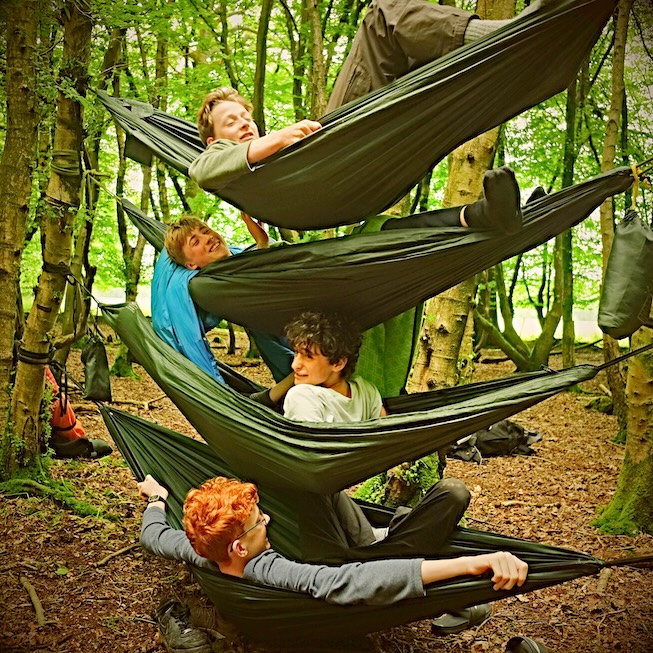
This is what happens on our weekends – no phones, no distractions, no escape routes. Just time in the woods mucking around in a feisty tribe.
Feral Fathers runs lively weekend camps for fathers and children in Sussex woodland (for ages 8+) and multi-day expeditions in the hills (ages 12+).
Learn more about woodland weekends →
Learn more about expeditions →
Email: cpacke@yahoo.co.uk | WhatsApp: 07940 272474