
teenage girls

Why banning social media for under-16s won’t fix “teen screen addiction” (and what actually helps)

Australia’s done it, and it looks like the UK might follow: banning some of the major social media platforms for under-16s.

Many parents feel relief that the thing they believe is wrecking attention, mental health, and even basic conversation might finally be addressed.

I understand the relief.  Over the last decade I’ve brought countless groups of teenagers into the woods on expeditions and outdoor events. When I speak to parents beforehand, they often describe what they’re seeing as “screen addiction.”  I’m not convinced that’s quite the right word – but it does point to something real.

And it’s not just the parents who feel relief. On these events I’ve noticed a consistent pattern when teenagers walk away from their phones: a visible unwinding.  Nervous energy settles. Many clearly appreciate being phone-free for more than 48 hours.

I’ve also noticed how quickly the phones come back out the moment they get into the car at pickup.

So – a social media ban. OK.

The problem is a familiar one, so allow me a cliché: the ban treats the symptom, not the cause.

What a social media ban might actually do

Restricting social media is probably a worthwhile move.

Tech companies design powerful platforms that are engaging, frictionless, and endlessly novel – that is literally what they exist to do. Teenagers aren’t yet equipped to regulate something that powerful, yet we gave them unrestricted access and were shocked at the problems that emerged.

If the ban is implemented in a way that teenagers don’t immediately bypass (a big assumption), it may create some useful space. Less comparison. Less cyberbullying. Less exposure to genuinely strange and harmful content.  Any clear boundary would be a positive outcome.

But the impact is likely to be limited.

After a ban, many teenagers would still struggle to sit with boredom (the importance of which I have written in a specific post here). They’d still have a low tolerance for difficulty or uncertainty (the importance of hardship I have written about in a post here). And so they’d still reach for distraction the moment something felt uncomfortable.  As far as I can tell, many smartphone-era teenagers haven’t learned what to do with themselves when there’s nothing to do.

And if we’re honest, many adults have forgotten too.

The real addiction: escaping discomfort

Nir Eyal, who researches distraction and wrote Indistractable, makes a crucial point: we don’t get distracted by our devices — we get distracted away from discomfort.  The device is just the escape route.

Teenagers aren’t on social media so much simply because the apps are compelling. They’re constantly there because the apps offer immediate relief from uncomfortable feelings: boredom, loneliness, anxiety, awkwardness, uncertainty.

Those feelings are normal human experiences. Social media didn’t create them – it just became the fastest way to avoid feeling them.  Take the phone away, and the feelings don’t magically disappear. Without new skills, teenagers will simply find the next available escape – whatever is still allowed.

This continues until they learn how to stay present with discomfort without immediately numbing or avoiding it.

How we created the vulnerability

We’ve built a world where discomfort has been steadily engineered out of teenage life.  The house is never too hot or cold.  Boredom is treated as a problem to be solved within seconds.  Physical challenge is limited, so teenagers rarely discover what they’re capable of handling.  Free roaming has shrunk, meaningful risks have diminished, and weekends are scheduled so tightly there’s little room to figure out what to do with themselves.

None of this is malicious. It’s convenience, safety, good intentions – layered over decades. But the result is that external discomfort has been removed almost entirely. And then we handed them a device that provides instant relief from internal discomfort.

Are we really surprised they struggle to put it down?

Why the outdoors helps so much

Outdoor environments remove escape routes and reintroduce manageable discomfort – all at once.

Bored? There’s no phone. But there’s a fire to watch, and it doesn’t look like much until you’ve watched it for a while. Cold? You can’t turn up the heating, but you have that fire, so add a log, add layers, move around.  Tired?  There’s work that still needs doing – shelter, food, water – but you’ll sleep well afterwards.  Socially awkward?  You can’t disappear into a screen, but sitting quietly is also fine.

Outdoors, teenagers can rebuild a skill modern life has made much harder to develop: tolerance for discomfort. Boredom, uncertainty, physical challenge, difficult feelings – all survivable, all developmental, all temporary.  Generally, from what I’m told directly by teenagers, they lead to “the best time ever” (especially on multi-day trips, which have huge benefits that I talk about here).

But you can’t learn any of this with a constant escape route in your pocket.

What parents still need to do after a ban

After a ban, parents would still have real work to do.

Actively teaching tolerance for discomfort matters – modelling it, setting boundaries, resisting the urge to rescue.  But the most effective approach has always been experiential: giving teenagers environments where they learn these skills themselves, through doing rather than being told.

That includes:

  • Unstructured time: no screens, no organised activities.
  • Physical challenge: hiking, camping, building things, long days outdoors.
  • No immediate escapes: phone-free meals, journeys, weekends – for adults too.
  • Room to struggle: resist rescuing them from every hard moment.

Most important of all is modelling. If we reach for our phones at every awkward silence or dull moment, we teach them that discomfort should be avoided.

There’s harder work to be done than banning things

The social media debate is a useful step, but it isn’t a solution. It’s part of a wider pattern of only looking for external forces to blame, while not also looking to individual behaviour and accountability, which I write about here.

The real question is: what do we do with the space a ban creates?

Do we fill it with different screens and distractions, or do we help teenagers rediscover boredom, uncertainty, effort, and the quiet confidence that comes from handling them?

That work can’t be outsourced to policy.  It requires parents to tolerate our own discomfort too: watching our children struggle, stepping back, and – perhaps hardest of all – putting our own phones down.

—-

About Feral Fathers

This is what happens on our weekends – no phones, no distractions, no escape routes.  Just time in the woods mucking around in a feisty tribe.

Feral Fathers runs lively weekend camps for fathers and children in Sussex woodland (for ages 8+) and multi-day expeditions in the hills (ages 12+).

Learn more about woodland weekends → 
Learn more about expeditions →

Email: cpacke@yahoo.co.uk | WhatsApp: 07940 272474
Why multi-day expeditions work better than day trips for teenagers

Day trips are the backbone of teenage life: the day at the outdoor activity centre, the forest school session.  They are good. They get you out, and they create memories.

But they don’t change anyone.

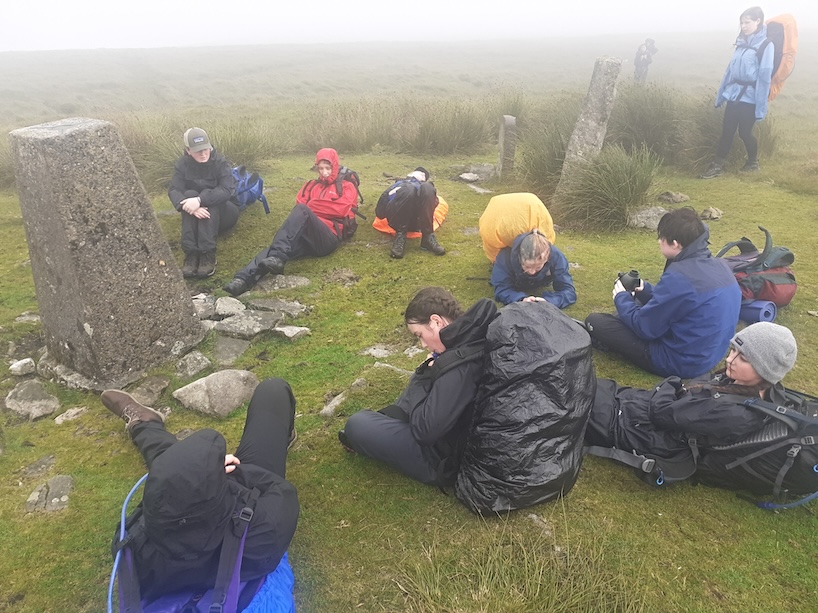
Multi-day expeditions – three, four, five days in places like Dartmoor or the Lake District – do something fundamentally different. Not because they are longer versions of the same thing, but because duration itself creates conditions that brief experiences simply cannot.

Teacher James Herndon, writing about education in How to Survive in Your Native Land (a remarkable, irreverent book), observed that schools operate on ‘artificial time’ – bells, lessons, arbitrary schedules disconnected from natural rhythms or real needs.  Learning that matters, he argued, requires proper time to unfold.

The same is true in other experiences, especially in the outdoors.  Day trips operate on borrowed time, while multi-day expeditions operate on lived time. For teenagers discovering who they are, that duration transforms the experience entirely.

The second day is when it actually begins

Day one of any outdoor trip runs on nerves first, and then quickly onto excitement.  Everything is new, there’s a significant undertaking ahead, and adrenaline is at work.  Teenagers are still their ‘weekend selves’, just in a different location (I think of it as an ‘indoors mode’).

Day two is different.

The thrill has worn off.  They’re just… here.  On the ground, in yesterday’s clothes, with a day ahead.

They have now arrived.  This is when the real experience begins.

On day trips, this point is never reached. It’s over before the novelty wears off, before anything uncomfortable has to be fully worked through. (I write here about the importance of boredom and avoiding escape routes).

Multi-day expeditions force teenagers through a wide arc of emotion and experience, varying cycles of highs and lows that accumulate into a layered adventure.  By day two or three, they’re not doing the expedition anymore. They’re living inside it.

Gary Snyder writes about the difference between visiting wilderness and inhabiting wildness.  Day trips are visits. Multi-day, you stop visiting.  You become an inhabitant, temporarily – you begin to integrate with it, and gain a sense of being at home in the world.  For a teenager, that wild feeling of belonging in nature is crucial to wellbeing, and profoundly underrated.

Time reveals who they actually are

Teenagers are trying on identities. Some feel real, while some are provisional. It takes robust challenges that test which identities are genuine and which are just performance.

On day trips, the unripe identities stay intact.  There’s not enough time, discomfort, or consequence for anything deeper to surface.

On multi-day expeditions, something else happens. By the second or third day, maintaining a persona becomes harder than simply being yourself.  Energy is finite – the loud one gets tired, the anxious one discovers they cope, the quiet one finds a moment to step forward.

I love how this unveils itself, without any force applied.  Duration does the work, revealing who the actually are.

For a teenager, discovering who they are when they can’t hide is invaluable.  It helps them find their feet… which, even though they have just grown three sizes in six months, is a surprisingly challenging task.

Consequences stretch across days and actually teach something

Modern teenage life is remarkably forgiving: mistakes get reset overnight, discomfort is usually temporary, and poor choices rarely echo forward, allowing the same mistakes to be repeated with low cost.

School operates on what Herndon called “artificial consequences” – grades, detentions, punishments entirely disconnected from the actions themselves.  Get a bad mark, nothing real changes the next day, because there’s no genuine feedback loop.

School operates on what Herndon called ‘artificial consequences’ – grades and detentions disconnected from the actions that caused them. The feedback arrives later, imposed by authority, unrelated to natural results. Get a bad mark on Thursday, your Friday feels exactly the same.  The feedback loop is broken.

Multi-day expeditions restore natural consequences.

Pack your rucksack poorly on day one (or bring one that doesn’t even fit you), your shoulders hurt on day two.  Smash through your snacks on day one, and you’re reduced to begging by the next day.  Allow your feet to get wet, or don’t dry your socks when you do, and you’ve got cold feet for the remainder.

These aren’t punishments, they’re just reality providing clear feedback.  The magic in this is that there is moral development without any moralising.  And because consequences stretch across time, there’s space to adjust, learn, try again.  This is how humans learned for thousands of years before we built systems that protect us from feedback.

So as much as I would love to teach them that their choices shape tomorrow’s experience, that laziness compounds, that you can’t outsource your comfort, and that cooperation isn’t optional when you’re stuck together, it’s better to leave it to be spoken by the hill.  

Real bonds require time – not bonding exercises

One-day outdoor experiences keep groups polite, and roles stay shallow.  I don’t think many individuals are being their raw selves in one of those “3, 2, 1 Let’s Go!” teambuilding situations.

Multi-day expeditions remove that option.  After a hard day’s walking followed by an iffy night’s sleep under a noisy owl, edges start to show.  Especially when faced with the prospect of the same again today.

This sounds negative, but it’s not.  Although we like to applaud positivity, there’s nothing that unites a group like a good whinge.  So… maybe it is negative, but in such a positive way!

It’s the beginning of honesty.

Because there’s no exit, people have to work through it. No one can retreat into politeness or performance; it wouldn’t work. Shared reality replaces social manoeuvring.

This is how trust actually forms: not through bonding exercises, but through staying when things get uncomfortable – and discovering that the group holds.  The result is earned membership and belonging

Group alchemy only happens when there’s time for things to get real.

The inner clock resets

Remember that bad night I mentioned earlier?  That just tends to be Night 1, when they have yet to fully exit ‘indoors mode,’ which is the one where it’s possible to get mad at an owl.

As indoor mode and artificial time fades, without phones, without schedules, without extraction times… there’s a physiological shift.

Sleep deepens.  Teenagers sleep better than they have in months – they are sleeping because it’s dark and they are tired.

Hunger becomes intelligible. “It’s time to eat” is replaced by “I’m actually hungry now.”

Attention stretches, because there is nothing fixing it in place.

When this happens, they are going beyond merely “slowing down” and into internal regulation.  

Their nervous systems recalibrate in prolonged nature time. Circadian rhythms reset to natural light-dark cycles, away from artificial disruptions.  The result is that they feel different, even if they can’t quite put their finger on it.

It’s great to experience your own biology again.

Why this matters

Institutions are a fact of life.  They are essential at scale. But institutional life is characterised by time management, performance measurement and other group-level objectives, and so it encourages orthodoxy over diversity, conformity over individual pace.

For teenagers who are developing at such a rapid rate, it is essential to have time outside of this. Experiences where the unique, slow or quirky can have their time, where masks drop and systems reset. It’s also where parental relationships can really deepen – in different ways with fathers and sons, and with fathers and daughters.

Healthy adolescence cannot be a factory where grown-ups are forged.  It’s a period of individual transformation—messy, uneven, unpredictable.  Transformation needs time and space, which is not something that institutional settings will provide.

That’s why through human history you have seen teenagers enduring prolonged challenges out in nature… and when I’m around, you’ll still see them.

—-

I’m a Mountain Leader who runs multi-day expeditions for teenager groups, and for fathers and children (12+) in Dartmoor, Snowdonia, the Peak District, and the Lake District – as well as weekend camps for fathers and children (ages 8+) in Sussex woodland.

These experiences are designed for duration to do its work, and get you fully out of ‘indoor mode’.

Learn more about woodland weekends → 
Learn more about expeditions →

Email: cpacke@yahoo.co.uk | WhatsApp: 07940 272474
Why daughters need their dads in the wilderness

Your daughter is strong. Stronger than the world tells her she is.

After around age 10, something shifts, in a way that is often challenging for dads. Girls begin navigating an increasingly complicated landscape: friendships become charged with social risk, bodies change in ways that feel public, and the pressure to be perfect, pretty, and pleasing intensifies.

And often, right when she needs you most, you might find yourself pulling back.

Not consciously or deliberately; I experienced it in the beginning with my daughter as a sort of involuntary recoil, which felt very jarring in the moment.

Adolescence makes many fathers uncomfortable around their daughters – that is definitely a thing.  The easy physical closeness of childhood can become awkward, sometimes quite suddenly.  You’re not sure how to be anymore, so you step back, assuming she needs space or preferring her mother handle “girl stuff.”

Research shows this retreat happens consistently across cultures. Psychologist Lisa Damour calls it one of the great losses of adolescence – not for the daughter alone, but for both of you. I have written how there is an important window not to be missed for fathers and sons, and it is true for daughters too.

But there’s a way to stay close that navigates the awkwardness very effectively: take her into the wilderness.

Why fathers often retreat (and what that costs)

Puberty changes things for fathers and daughters in ways it doesn’t for fathers and sons.

Many fathers report feeling suddenly uncertain – your daughter’s body is changing, social dynamics are confusing, and the easy physicality of childhood (wrestling, carrying her on your shoulders) no longer feels appropriate.  There is so much baggage around men and girls in our culture.  The fear of being seen as inappropriate – even predatory – around a developing girl keeps many fathers at arm’s length.  It shouldn’t, but it does.

So you default to distance.  You let her mother handle the “complicated stuff.”  You focus on being the provider, the problem-solver from a distance, the one who doesn’t make things more awkward by trying too hard.  This clear step back can happen at precisely the time when fatherhood becomes most vital.

Mary Pipher, in Reviving Ophelia, describes what this retreat costs: daughters lose access to the adult who could show them that women are strong people who do hard things, not just people who look a certain way and manage social approval.

Rachel Simmons’ research on teenage girls found that fathers staying engaged – physically active together, taking daughters seriously, treating them as capable – directly protects against a confidence collapse many girls experience in adolescence.

The wilderness solves the awkwardness problem because you’re not facing each other trying to “connect.”  You’re both facing outward toward a shared task: navigating to camp, building a fire, setting up shelter, figuring out where you are.

There’s something to do, something real.  The focus isn’t on each other – it’s on the work in front of you.

And that makes staying close possible, even easy, precisely when your relationship might otherwise become strained.

What your daughter is learning about her body (and why it matters what you show her)

There are powerful cultural narratives aimed at teenage girls about their bodies.  Expressed bluntly:

Your body is for other people to look at and evaluate.
Your worth is determined by how you appear.
Your body is decoration, not a tool.
Being pretty matters more than being strong.

Peggy Orenstein’s research in Girls & Sex found that when girls describe their own bodies, they overwhelmingly use appearance-based language. Very few describe their bodies as sources of strength, capability, or power, unless they have been specifically encouraged to do so.

The wilderness reverses this completely. Time outdoors, as I have written, matters for fathers and sons. It matters to for fathers and daughters, but in a different way.

In the woods, your daughter’s body isn’t something to be looked at – it’s something she uses.

Climbing, carrying, building, hiking.  She solves problems that require physical engagement.  Her body becomes clearly and unmistakably a tool, not an object.

When a girl discovers she can handle what the wilderness throws at her, she learns a lesson that runs counter to some of the loudest cultural messages.

Girls who develop physical competence — through sport, outdoor challenge, or hands-on work — consistently show higher self-esteem, stronger body image, and greater resilience to peer pressure and cultural messaging. Later in life, this competence often shapes how they approach intimacy and relationships.

My daughter once told me that the way I treated her as a teenager shaped the level of respect she now expects from a partner.  This insight was profoundly moving, and one I could never have planned, only hoped to support.

So, this isn’t just about “building confidence.”  It’s about fathers playing a fundamental role in how daughters see their own bodies and their relationships.

When fathers stay engaged through adolescence, daughters learn something about how men can be.  They don’t have to guess.

Why “Dangerous Daughters” matters

I have run weekends called “Feral Fathers, Dangerous Daughters” since 2019, and it is named that way deliberately.

Not because we’re doing objectively dangerous things (though we do take manageable risks).  It’s because “dangerous” goes against something culture tells girls they’re not allowed to be.

Rachel Simmons describes the “curse of the good girl” – the expectation that girls should be nice, well-behaved, perfect and pleasing.  But the wilderness has no interest in any of this.

You can’t be “nice” to a fire that won’t start – you have to problem-solve. You can’t stay clean and pretty when there is no shower or mirror, and when no-one cares how you look. You can’t be quiet and small when you are chasing someone else’s dad through the trees.

The wilderness requires girls to be loud, messy, direct, and assertive.  Not performing femininity, just being a person solving problems.

See – it’s not unfair for me to have thought they looked bedraggled

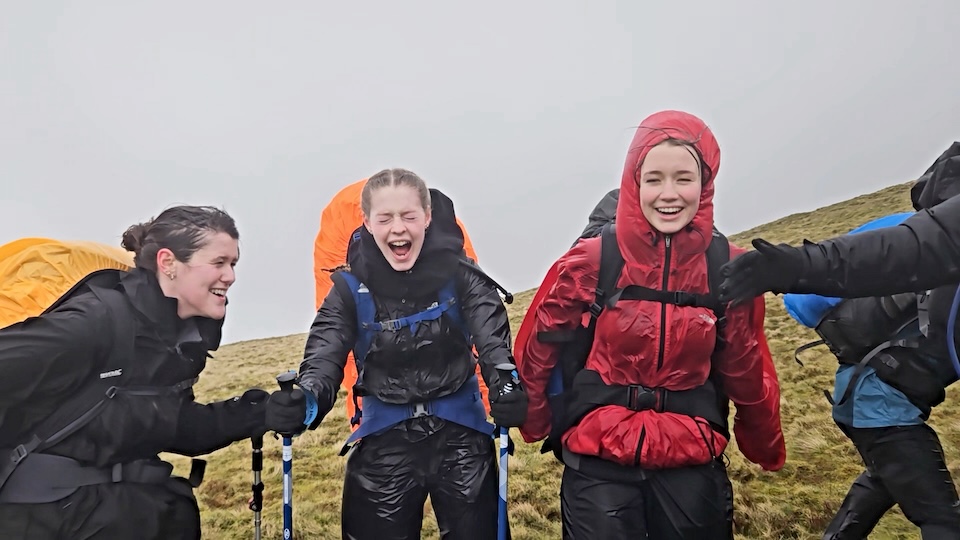
I was with a group of 15 year-old girls on an expedition in Dartmoor, and for a period of four hours on the moor, the weather was absolutely filthy.  I was a bit concerned that the wind and rain might put them off.  On the face of it, they looked so tired and bedraggled.

Later that evening, when the elements had eased and they were cooking their meal ahead of the night wild camping by the River Dart, one of them said: “I’ve done a lot of outdoor stuff with craft and circle time, and that’s fine, but what I really love is to get smashed in the face by a storm.”  To my delight, the entire group agreed, as they tucked into the chorizo and pasta chicken soup they had made.  The next spring, they were happily in the mountains of the Lake District, getting another “storm facial”. They learnt first hand the benefits of getting properly away on multi-day expeditions.

“Dangerous” means: skilful, assertive, and tough.  Shouting back at storms.

It means reclaiming what girls are so often told to suppress.  But something unexpected happens for the fathers too…

I do mean literally shouting back at a storm

It’s not just the daughters who grow

When fathers reflect on time in the wilderness with their daughters, what surprises them most is not what the girls gained – but what it gave them back.

“My daughter and I had a magical time… and bonding on a level I am not sure it is really possible to do in our everyday lives. It was quite strange re-entering civilisation.  Never again will I tell her to be careful with a sharp knife in the kitchen!” (David)

“That weekend felt like some of the most precious time we’ll ever spend together. I learnt so much about her that I don’t think I would’ve learnt any other way.” (Rick)

A storm in her face helps her face anything

The storm raged around us, the rain lashing and the wind howling.  And yet, in the middle of it, the girls were alive, surefooted, and unafraid… and I felt it too. They were shouting, laughing, and experiencing a freedom the world often tells them they shouldn’t have.

That day, they learned something bigger than any skill: they learned that they can face the elements, and life, head-on.

This is what remaining connected can look like – not smoothing the weather, but standing close while she meets it.

The best lessons aren’t taught, they’re lived.  So take your daughter into the storm.  Let her shout at it, hair everywhere – and let yourself rediscover the wildness of being a father along the way.

—-

Feral Fathers runs Dangerous Daughters weekends specifically for fathers and daughters (ages 8+) in Sussex woodland, along with mixed family weekends and multi-day hill expeditions (ages 12+).

Small groups, no phones, lots of fun and freedom.

Learn more about woodland weekends → 
Learn more about expeditions →

Email: cpacke@yahoo.co.uk | WhatsApp: 07940 272474