
Boredom has a terrible reputation.
We treat it as a problem to be solved, a sign that something is wrong, or that we’ve failed to provide enough stimulation. If a teenage boy is bored, our instinct is to fix it quickly.
And now we can… instantly… infinitely! A few taps and boredom disappears.
From my experience working with teenage boys outdoors over the last decade, I’ve come to think this is one of the most significant but under-the-radar problems we’ve created.
Not because boredom is harmful, but because it’s essential, and we’ve almost completely removed it from boys’ lives.
What boredom actually is
Boredom isn’t a sign that something has gone wrong. It’s the uncomfortable feeling that arrives when nothing is demanding your attention – and it used to be one of the most productive states a teenager could find themselves in.
If you don’t rush in to fix it, boredom usually starts doing something valuable. Anyone who grew up before constant screens will recognise this. Boredom led to dens, daft games, tinkering, wandering, arguing, inventing things, staring out of windows (I said “valuable”, not “productive”!)
It was the doorway into engagement – not something to be eliminated.
How screens change the equation
Screens short-circuit boredom completely.
They offer constant stimulation and novelty with zero effort, instantly erasing the small gaps where boredom might otherwise do its work. There’s no need to sit with the uncomfortable gap where something might emerge: the moment boredom appears, it’s gone.
The issue isn’t that screens are evil or uniquely powerful, it’s that they are always available, and they remove the pause where something internal might develop.
Over time, boys don’t learn what boredom turns into — because they never stay in it long enough to find out.
What I see when screens are removed
In the first few hours of a phone-free outdoor weekend, there’s often a low-level restlessness.
It often manifests as walking around, hitting a tree with a stick, which I happen to think is an excellent way to pass the time. I once found the Chairman of Pret a Manger and Itsu doing just this in my woodland, ten minutes after arriving.
The fire has leaf litter chucked in it a lot at first, and there’s a lot of talk about gaming. Then something shifts.
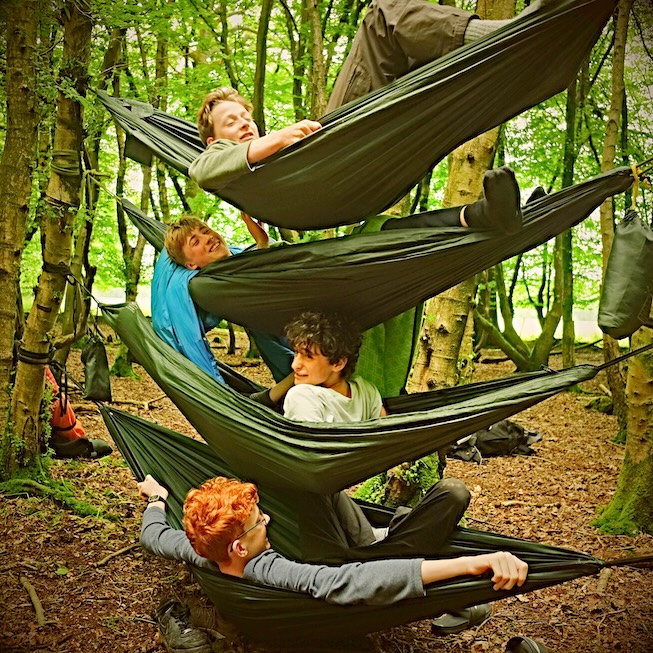
Alongside tasks, activities and games, I alternate with generous periods of no structure or direction. And after a while, I notice how they begin to settle into this. You can tell the shift is happening when the focus moves away from destruction and more towards construction: they ask if they can carve a spoon, they go off to make their own fire, or they see how many people can fit into a precarious quadruple-decker hammock setup they have created.
Why teenage boys need boredom specifically
Adolescence brings restlessness, awkwardness, uncertainty, and social self-consciousness – truly the best days of our lives! Boredom is often the space where boys learn to tolerate these feelings without escaping them immediately.
When boredom is constantly eliminated, something else fills the gap – usually distraction. Not because boys are weak, but because they’ve never had reason to develop an alternative.
Many boys know what Creative Mode feels like in a game – that open-ended state where they build and invent without being told what to do. Real life has a very good version of this, but screens prevent the boredom that carries them there.
Boredom builds something important. When boys sit in it long enough, they learn to tolerate discomfort without escaping it – and that tolerance is the foundation everything else rests on. Focus, initiative, confidence: these can’t be taught directly. They emerge from the other side of boredom.
This is particularly true on multi-day trips, where real life really has the opportunity to influence the experience.
Adults struggle with this too
Adults aren’t much better. We’re just as awkward with silence, and we’ve dressed our own screen dependency up in more respectable clothing: Important Messages, Vital Googling, Admin.
Teenagers are watching this constantly. If we treat every gap as something to fill, they will too.
Let boredom do its work
Boredom needs two things: time, and the absence of easy escape routes.
The outdoors provides both naturally. Screens are physically absent, with no obvious alternatives. And time stretches – which is how my generation spent entire summer holidays doing ‘nothing.’ Dads can harness this memory and relive it with their sons. It does wonders for the son, and for the father-son relationship, to get outdoors together.
The fire quest – fourteen hours alone in the dark tending a fire – is boredom in its most concentrated form. No phone, no watch, nothing to do except tend the fire and sit with what arrives. (Read about the fire quest here →)
Boredom is where agency begins. It’s the moment a teenager realises: I can do something with this. We don’t give that moment anything like the weight it deserves.
At home, it’s much harder, because screens are everywhere and habits are entrenched. Lecturing boys about screens or attention won’t get the result we want as parents, it just leads to tantrums. Energy is better spent on exposing him to constructive discomfort, and resisting the urge to rescue him from it… which is most effectively achieved outside.
Once they’ve discovered what lies on the other side of boredom – in the woods, away from screens – that knowledge comes home with them. It doesn’t solve everything, but it builds a healthy habit to counter the screen effect: to stay in the uncomfortable moment, knowing that it’s a place worth staying.
—-
If you want to experience this kind of environment directly, Feral Fathers runs woodland weekends for fathers and children (ages 8+) and wild camping expeditions in the hills (ages 12+).
You don’t need to be an outdoorsman. You just need to turn up and muck around.
Learn more about woodland weekends →
Learn more about expeditions →
Email: cpacke@yahoo.co.uk | WhatsApp: 07940 272474